

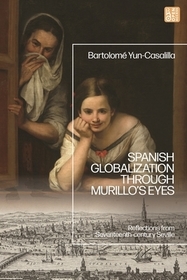
Spanish Globalization through Murillo's Eyes
Reflections from Seventeenth-century Seville
- Publisher's listprice GBP 85.00
-
38 377 Ft (36 550 Ft + 5% VAT)
The price is estimated because at the time of ordering we do not know what conversion rates will apply to HUF / product currency when the book arrives. In case HUF is weaker, the price increases slightly, in case HUF is stronger, the price goes lower slightly.
- Discount 20% (cc. 7 675 Ft off)
- Discounted price 30 702 Ft (29 240 Ft + 5% VAT)
- Discount is valid until: 30 June 2026
Subcribe now and take benefit of a favourable price.
Subscribe
38 377 Ft

Availability
Estimated delivery time: In stock at the publisher, but not at Prospero's office. Delivery time approx. 3-5 weeks.
Not in stock at Prospero.
Why don't you give exact delivery time?
Delivery time is estimated on our previous experiences. We give estimations only, because we order from outside Hungary, and the delivery time mainly depends on how quickly the publisher supplies the book. Faster or slower deliveries both happen, but we do our best to supply as quickly as possible.
Product details:
- Publisher Bloomsbury Publishing (UK)
- Date of Publication 19 February 2026
- Number of Volumes Hardback
- ISBN 9781350528772
- Binding Hardback
- No. of pages328 pages
- Size 236x160x22 mm
- Weight 680 g
- Language English
- Illustrations 50 colour illus 681
Categories
Long description:
This open access book examines the work of the 17th-century Baroque painter, Bartolom- Esteban Murillo (1618-1682) - a figure who barely left the city of Seville - as a way of understanding globalization, its consequences, and its limits.
Full of saints, friars, virgins, and Christs, or poor people and cheerful p-caros oblivious to social injustice, Murillo's painting has been considered representative of the Counter-Reformation and the exponent of an immobile, even introverted, society that regressed with the 'crisis of the 17th century'. Spanish Globalization through Murillo's Eyes introduces a global perspective by considering the Atlantic art market and developing comparisons with Protestant paintings and an analysis of Murillo's iconography alongside the social and political theory of his time. Such comparisons and analyses illuminate a different image, emphasizing the idea of a common European path towards modernity, individualism, emotional self-control and social change.
The book also examines how Murillo's contemporaries interpreted his iconography. The result is a new and sharper understanding of the tensions created by globalization in the field of art, in the construction of imagined communities, and in social relations in the early modern era.
The ebook editions of this book are available open access under a CC BY-NC-ND 4.0 licence on bloomsburycollections.com.
Table of Contents:
List of Illustrations
Foreword
Introduction: Seville and Murillo
Part 1 - Seville and Murillo in Atlantic Pictorial Networks
1. Art Markets, Colonial Trade, and Painters in a Global City
Part 2 - Between America and Europe
2. American Experiences and Sevillian Traditions
3. Globalization and Confessionalization: Family, Women, and Virtue in the Dutch Mirror
Part 3 - Globalization and Seville's Elites
4. Passions, Self-Discipline, Religious Conversion, and Family Conflicts: The Theme of the Prodigal Son
5. Self-Representation: Aristocracy, Individualism, and Noble Values
Part 4 - Globalization, Christian Tradition, and Popular Conflict
6. Work and Family: A Franciscan and an Artisans' Painter
7. Egalitarian Images, the Moral Economy, and Layers of Globalization in the City of God
Part 5 - Global Contexts and Symbols of Nationhood
8. The 'Republic' and the 'Monarchy' of Spain in Sevillian painting: On the Immaculate Conception and Ferdinand III
Conclusion: Murillo, Spain and seventeenth-century Seville
Bibliography
Index

