

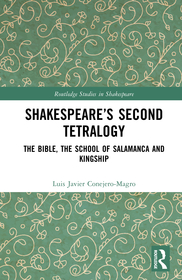
Shakespeare’s Second Tetralogy
The Bible, the School of Salamanca and Kingship
Series: Routledge Studies in Shakespeare;
- Publisher's listprice GBP 155.00
-
69 982 Ft (66 650 Ft + 5% VAT)
The price is estimated because at the time of ordering we do not know what conversion rates will apply to HUF / product currency when the book arrives. In case HUF is weaker, the price increases slightly, in case HUF is stronger, the price goes lower slightly.
- Discount 20% (cc. 13 996 Ft off)
- Discounted price 55 986 Ft (53 320 Ft + 5% VAT)
- Discount is valid until: 30 June 2026
Subcribe now and take benefit of a favourable price.
Subscribe
62 984 Ft

Availability
Not yet published.
Why don't you give exact delivery time?
Delivery time is estimated on our previous experiences. We give estimations only, because we order from outside Hungary, and the delivery time mainly depends on how quickly the publisher supplies the book. Faster or slower deliveries both happen, but we do our best to supply as quickly as possible.
Product details:
- Edition number 1
- Publisher Routledge
- Date of Publication 22 July 2026
- ISBN 9781041097044
- Binding Hardback
- No. of pages232 pages
- Size 229x152 mm
- Language English 700
Categories
Short description:
Shakespeare’s Second Tetralogy explores the profound and multifaceted relationship between William Shakespeare’s historical dramas and biblical intertextuality.
MoreLong description:
Shakespeare’s Second Tetralogy explores the profound and multifaceted relationship between William Shakespeare’s historical dramas and biblical intertextuality. This study moves beyond reductive compilations of biblical references or sectarian interpretations, delving instead into the aesthetic and stylistic functions of these intertextual elements in Shakespeare’s second tetralogy. The book’s originality lies in the way it examines how biblical allusions and echoes shape characters, situations, and narrative structures, offering a nuanced understanding of Shakespeare’s creative integration of scripture. By treating these intertexts not merely as theological or moral markers but as rhetorical and artistic tools, the study reveals new dimensions to Shakespeare’s engagement with the Bible. The research situates Shakespeare’s historical dramas within the important context of Anglo-Iberian intellectual exchanges. It re-examines Shakespeare’s Spanish sources, particularly in relation to the theories of kingship and natural law proposed by the School of Salamanca, and draws on the works of the Dominican Francisco de Vitoria to explore themes of sovereignty and modernity. This approach highlights how Shakespeare updated mediaeval characters and ideas while retaining their traditional elements, creating complex portrayals that resonated with both Renaissance and contemporary audiences. By intertwining literary analysis with historical research, the study underscores the structural and thematic importance of biblical imagery in shaping Shakespeare’s vision of kingship. The book therefore addresses a critical gap in Shakespeare studies, offering scholars and students a fresh perspective on how biblical intertexts function as dynamic aesthetic and political tools in his plays.
MoreTable of Contents:
Introduction
Chapter 1 – Biblical Intertextuality and the School of Salamanca
Chapter 2 – Richard II and the Old Testament
Chapter 3 – Limited Biblical Reference in Henry IV
Chapter 4 – Falstaff’s Distortion of Biblical Reference
Chapter 5 – Prince Hal: Bridge between the Old and the New Testaments
Chapter 6 – Henry V’s Recurrent Use of the Gospels
Chapter 7 – Conclusions
More

