

-
GET 18% OFF
- Publisher's listprice GBP 85.00
-
38 377 Ft (36 550 Ft + 5% VAT)
The price is estimated because at the time of ordering we do not know what conversion rates will apply to HUF / product currency when the book arrives. In case HUF is weaker, the price increases slightly, in case HUF is stronger, the price goes lower slightly.
- Discount 18% (cc. 6 907 Ft off)
- Discounted price 31 470 Ft (29 971 Ft + 5% VAT)
- Discount is valid until: 31 October 2026
31 470 Ft

Availability
Not yet published.
Why don't you give exact delivery time?
Delivery time is estimated on our previous experiences. We give estimations only, because we order from outside Hungary, and the delivery time mainly depends on how quickly the publisher supplies the book. Faster or slower deliveries both happen, but we do our best to supply as quickly as possible.
Product details:
- Publisher Bloomsbury Publishing (UK)
- Date of Publication 17 September 2026
- ISBN 9781666948110
- Binding Hardback
- No. of pages288 pages
- Size 228.6x152.4 mm
- Language English 700
Categories
Short description:
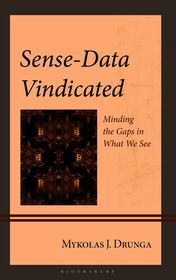
Connecting the perceptual time-gap problem with Subjective Idealism, this book argues for the existence of sense-data at the root of perceiving physical objects.
MoreLong description:
In order to solve the perceptual time-gap problem, this book embraces Idealism and acknowledges the existence of sense-data at the root of perceiving physical objects.
Of all the multiple arguments for introducing sense-data as objects of sensory awareness, the Time-Gap Argument remains persistently puzzling. Since the Middle Ages, scholars have wondered about phenomena such as the light we see from stars far away, and the time-gap problem has resisted a definitive solution.
Examining most of the arguments advanced since the beginning of the twentieth century both for and against the admission of sense-data, Mykolas J. Drunga argues that the problem cannot be solved by denying that the things we see must exist at the time we see them or by claiming we can see deeply into the past. Instead, we will solve it by realizing that what keeps the universe in existence is an eternal spirit. This radical conclusion, in conversation with the Idealist philosophers Leibniz and Berkeley, requires taking a first indispensable step--acknowledging the existence of sense-data at the root of perceiving physical objects.
Drunga vindicates a Direct Realist Subjective Idealism, which alone allows perception of the world to be both possible and understandable. If Subjective Idealism is thus a necessary condition for the possibility and intelligibility of sensory perception, we thereby have a strong proof of Idealism's truth. Ultimately, to be just is to perceive (to be on the way toward coming to know something) or to be perceived (to be on the way toward becoming known to someone).
Table of Contents:
Preface
Chapter 1: The Time-Gap Argument
Chapter 2: The Existence and Simultaneity Requirements
Chapter 3: Denying the Simultaneity Requirement
Chapter 4: Affirming the Simultaneity Requirement
Chapter 5: What and How Do We Perceive
Bibliography
Index

