

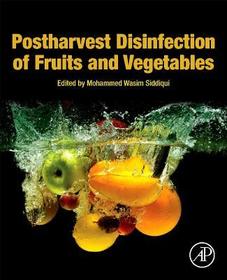
Postharvest Disinfection of Fruits and Vegetables
- Publisher's listprice EUR 143.00
-
59 309 Ft (56 485 Ft + 5% VAT)
The price is estimated because at the time of ordering we do not know what conversion rates will apply to HUF / product currency when the book arrives. In case HUF is weaker, the price increases slightly, in case HUF is stronger, the price goes lower slightly.
- Discount 10% (cc. 5 931 Ft off)
- Discounted price 53 378 Ft (50 837 Ft + 5% VAT)
Subcribe now and take benefit of a favourable price.
Subscribe
59 309 Ft

Availability
printed on demand
Why don't you give exact delivery time?
Delivery time is estimated on our previous experiences. We give estimations only, because we order from outside Hungary, and the delivery time mainly depends on how quickly the publisher supplies the book. Faster or slower deliveries both happen, but we do our best to supply as quickly as possible.
Product details:
- Publisher Elsevier Science
- Date of Publication 17 August 2018
- ISBN 9780128126981
- Binding Paperback
- No. of pages322 pages
- Size 234x190 mm
- Weight 680 g
- Language English 0
Categories
Long description:
Postharvest Disinfection of Fruits and Vegetables describes available technologies to reduce microbial infection for maintaining postharvest quality and safety. The book analyzes alternative and traditional methodologies and points out the significant advantages and limitations of each technique, thus facilitating both cost and time savings. This reference is for anyone in the fresh produce industry who is involved in postharvest handling and management. It discusses, in detail, the latest disinfection approaches, low-cost treatment strategies, management and protocols to control fresh produce qualities, diseases and insect infestation.
MoreTable of Contents:
1. Postharvest disinfection of fruits and vegetables: an overview
2. Postharvest diseases of fruits and vegetables: recent advances
3. Induced resistance in fruits and vegetables against biotic stress using GRAS compounds
4. Aqueous Formulations
5. Sodium hypochlorite (NaOCl)
6. Calcium hypochlorite (CaCl2O2)
7. Peracetic acid
8. Electrolyzed reduction water
9. Ultrasonic processing technology
10. Hydrogen peroxide (H2O2)
11. Physical Treatments
12. Irradiation
13. UV-A, B, and C
14. Ozone- Nikos
15. Plasma (thermal or cold plasma)
16. Chlorine gas
17. Sulfur dioxide
18. Chitosan

