

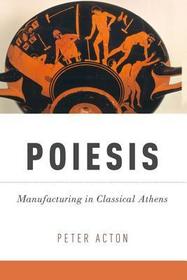
Poiesis
Manufacturing in Classical Athens
- Publisher's listprice GBP 46.99
-
21 215 Ft (20 205 Ft + 5% VAT)
The price is estimated because at the time of ordering we do not know what conversion rates will apply to HUF / product currency when the book arrives. In case HUF is weaker, the price increases slightly, in case HUF is stronger, the price goes lower slightly.
- Discount 10% (cc. 2 122 Ft off)
- Discounted price 19 094 Ft (18 185 Ft + 5% VAT)
Subcribe now and take benefit of a favourable price.
Subscribe
21 215 Ft

Availability
printed on demand
Why don't you give exact delivery time?
Delivery time is estimated on our previous experiences. We give estimations only, because we order from outside Hungary, and the delivery time mainly depends on how quickly the publisher supplies the book. Faster or slower deliveries both happen, but we do our best to supply as quickly as possible.
Product details:
- Publisher OUP USA
- Date of Publication 16 June 2016
- ISBN 9780190494346
- Binding Paperback
- No. of pages406 pages
- Size 234x156x22 mm
- Weight 621 g
- Language English
- Illustrations 40 illustrations and figures 0
Categories
Short description:
Brings together ancient texts and inscriptions, recent scholarly analysis, archaeological finds, and the expertise of modern craftsmen to investigate all that can be known of Athens' manufacturing activities
MoreLong description:
Poiesis brings together archaeological finds, ancient texts and inscriptions, recent scholarly analysis, and the expertise of modern craftsmen to investigate every known facet of Athens' manufacturing activities. Despite the fact that Athenians consumed great quantities of manufactured goods, and around half of the residents of classical Athens can be shown to have been dependent for survival on manufacturing in some form, the subject has been almost completely neglected by historians. The book draws on the analytical techniques of contemporary business economics--supply and demand, competition theory, and risk-return analysis--to explain events and choices. Manufacturing operations are classified in an original framework that explains why certain segments were suited to the sole craftsman and others to teams of slaves, and deduces earnings potential based upon barriers to entry and competitive differentiation. The result is a new and refreshing angle on how Athenian society operated that complements political, military, and literary perspectives, with important and often surprising implications. Among other insights the analysis shows how fragmented industry structures were fundamental to the workings of Athenian democracy by enabling citizens to supplement their income through casual manufacturing activity.
Acton takes on the whole of the manufacturing landscape of the classical Athenian polis with remarkable success .. it is difficult to find fault with his book, and some hard-won insights result from his comprehensive approach.
Table of Contents:
Foreword
Table of Contents
Acknowledgements
Chapter 1: Introduction
A. Athens, the Manufacturing City
B. Original Sources
i. Ancient Literature
ii. Archaeology and Epigraphy
C. Methodology
i. Embeddedness and Empirical Analysis
ii. Theories of Firm Size
iii. The Theory of Competitive Advantage
iv. Competitive Advantage and Industry Structure
v. Applying the Competitive Advantage Framework
Chapter 2: Industry Formation
A. Early Manufacturing
B. Homer and the Households of the Rich
C. Hesiod and the Peasant Economy
D. Empirical Evidence
i. Metalworking
ii. Leatherwork
iii. Cosmetics and Perfumes
iv. Textiles
E. Supply and Demand in a Competitive Market
Chapter 3: The Pottery Industry
A. The Evidence
i. Original Texts
ii. Pots
iii. Potteries and Kilns
iv. Stamps and Graffiti
v. Vase Paintings
B. Industry and Workshop Size
C. Labour Force
i. The Process of Making Pots
ii. Staffing Needs
iii. Justifying a Full-Time Team
D. Bases for Differentiation
E. Subsequent Changes in Competitive Dynamics and Industry Structure
F. Summary
Chapter 4: Mining, Metals and Armour
A. Mining
B. Ore Processing
C. General Metalworking
D. Jewellery and Ornaments
E. Coinage
F. Bronze Armour
G. Shield Manufacture
H. Knives
I. Summary
Chapter 5: Textiles, Clothing and Footwear
A. Textiles and Clothing
i. Spinning and Weaving
ii. Scouring and Finishing
B. Footwear
i. Tanning
ii. Shoemaking
C. Summary
Chapter 6: Woodworking
A. Furniture
B. General and Specialised Woodworking Segments
C. Boat Building
i. The Trireme: Development and Configuration
ii. Responsibility for Building Triremes
iii. Manufacturing: the Hull
iv. Manufacturing: Components
v. Shipbuilding and Supplying Industries
D. Summary
Chapter 7: Construction Industries
A. Public Buildings
B. Monumental Statues
C. Private Housing and Infrastructure
D. Summary
Chapter 8: Food, Drink and Personal Care
A. Agricultural Products
i. The Athenian Diet
ii. Processing
iii. Food Service
B. Cosmetics, Perfumes and Medicines
C. Summary
Chapter 9: Athens' Manufacturers
A. Citizen Investors
B. Citizen Craftsmen
C. Women
D. Foreign Residents
E. Slaves
Coda
Athenian Currency
Appendix: Quantifying Manufacturing Preparation
A. Supply Analysis
B. Demand Analysis
Secondary Sources
Photo Credits
Index

