

- Publisher's listprice GBP 100.00
-
45 150 Ft (43 000 Ft + 5% VAT)
The price is estimated because at the time of ordering we do not know what conversion rates will apply to HUF / product currency when the book arrives. In case HUF is weaker, the price increases slightly, in case HUF is stronger, the price goes lower slightly.
- Discount 10% (cc. 4 515 Ft off)
- Discounted price 40 635 Ft (38 700 Ft + 5% VAT)
Subcribe now and take benefit of a favourable price.
Subscribe
45 150 Ft

Availability
printed on demand
Why don't you give exact delivery time?
Delivery time is estimated on our previous experiences. We give estimations only, because we order from outside Hungary, and the delivery time mainly depends on how quickly the publisher supplies the book. Faster or slower deliveries both happen, but we do our best to supply as quickly as possible.
Product details:
- Publisher OUP Oxford
- Date of Publication 3 November 2011
- ISBN 9780199597239
- Binding Hardback
- No. of pages380 pages
- Size 223x146x36 mm
- Weight 600 g
- Language English 0
Categories
Short description:
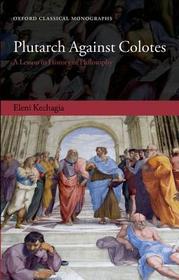
Kechagia rehabilitates Plutarch as a thinker and historian of philosophy by offering a critical analysis of Against Colotes, an anti-Epicurean treatise in which Plutarch discusses some of the most important philosophical theories. The book argues that Plutarch produces insightful philosophical interpretations of past theories.
MoreLong description:
Plutarch of Chaeroneia's philosophical work remained largely in the shadow of his celebrated Lives, partly because it was often dubbed 'popular philosophy', and partly because it was thought to be lacking in originality. The tides are, fortunately, changing and current scholarship is showing a growing appreciation of Plutarch's philosophical work. This book contributes to the 'rehabilitation' of Plutarch as a philosopher by focusing on an important aspect of his philosophical self: his work as a teacher, interpreter, and, eventually, historian of philosophy. Eleni Kechagia offers a critical analysis of Plutarch's anti-Epicurean treatise Against Colotes - a unique text that is both rich in philosophical material and has been widely used as a source for ancient Greek philosophy, but which has yet to be studied in its own right.
Combining a historical approach with structural analysis and close reading of selected sections of the text, this book demonstrates that Plutarch engaged with the philosophy of his past in a creative way. By refuting Colotes' Epicurean arguments against the main Greek philosophers up to the Hellenistic era, Plutarch gives an insightful critical assessment of the philosophy of his past and teaches his readers how to go about living and reading philosophy. The volume concludes that Plutarch emerges as a respected critic whose 'reviews' of the past philosophical theories are an essential companion when trying to piece together the puzzle of ancient Greek philosophy.
Table of Contents:
List of abbreviations
Note on editions and translations
Introduction
Part I: Plutarch s target
Why did Plutarch write against Colotes? Reading the prooemium of Against Colotes
Introduction
The prooemium under scrutiny
The dedication: Saturninus, lover of antiquity (1107D-E)
The circumstances: Platonic undertones and rhetorical disclaimers (1107E- 1108B)
The philosophical justification: pleasures of the belly and bad scholarship (1108B-E)
Conclusion: Colotes book as classroom material
Colotes of Lampsacus: the man and his philosophical background
Introduction: Colotes in context
Life and interactions with Epicurus
Overview of Colotes works
Against Plato s Lysis (P.Herc. 208)
Against Plato s Euthydemus (P.Herc. 1032)
Against Plato s Myths
Colotes, the Epicurean pamphleteer?
The tradition of Epicurean polemics and its significance
Colotes place in the history of the Epicurean school
Colotes polemic against the philosophers: a reconstruction
Introduction: methodological observations
Chronology, targets, and structure of Colotes book
The dedication to king Ptolemy and a possible dating
Colotes targets
Structure of Colotes book and Democritus centrality
Colotes main line of argument and underlying philosophical assumptions
Non-Epicurean philosophers make life impossible to live
Colotes method: catchy lines and arguments from everyday life
The underlying principle: philosophy as therapy
Epicurean physics and canonic in Colotes book
Colotes polemic as a protreptic
Part II: Method and argument in the Adversus Colotem
Structure of Plutarch s Adversus Colotem
The puzzle of the modified structure
In the quest of thematic coherence
The two reversals and Plutarch s explanation
Thematic groups in the Adversus Colotem
The epilogue, Epicurean ethics, and a schema emerging
Plutarch s omission of Melissus uncovered
A lesson in history of philosophy?
Plutarch s argumentative strategy
Methodological considerations
Plutarch s arguments in outline
Vindication arguments: setting the record straight
Overturning arguments: picking out inconsistencies
Plutarch against Colotes on Democritus' 'by convention'- thesis
Introduction
Colotes accusation against the 'by convention' - thesis (1110E-F)
Plutarch s overturning argument: disarmed? (1110F)
Plutarch s reading of Democritus 'by convention' - thesis (1110F-1111A)
The overturning argument revisited: sensible qualities and the Epicurean inconsistency (1111B-D)
Plutarch s criticism of Epicurean atomism (1111D-F)
Conclusion
Plutarch against Colotes on Platonic ontology
Introduction
Colotes against Platonic ontology (1115C-D)
Plutarch s vindication argument (1115C-1116C)
Plutarch on the true meaning of 'not-being'
Plutarch on the theory of Forms
The overturning argument: Epicurean atoms and Platonic Forms (1116C-D)
Where did Epicurus go wrong? (1116D-E)
Conclusion
Plutarch against Colotes on the Cyrenaic apprehension of (?)
Introduction
Colotes criticism of Cyrenaic epistemology (1120C-D)
Plutarch on Cyrenaic subjectivism (1120D-F)
Plutarch s overturning argument: Epicurean images and Cyrenaic affections
On the inconsistency of the Epicurean all sense impressions are true
Conclusion
Epilogue: lessons from Plutarch
Appendix I
Colotes of Lampsacus: On the fact that according to the doctrines of the other philosophers it is impossible even to live
Appendix II
Colotes and scepticism
Appendix III
The Democritean 'no more', its variants, and Plutarch s reading
Bibliography
Index

