

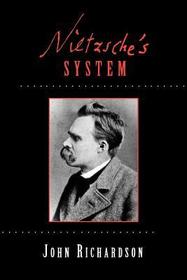
Nietzsche's System
- Publisher's listprice GBP 49.99
-
22 570 Ft (21 495 Ft + 5% VAT)
The price is estimated because at the time of ordering we do not know what conversion rates will apply to HUF / product currency when the book arrives. In case HUF is weaker, the price increases slightly, in case HUF is stronger, the price goes lower slightly.
- Discount 10% (cc. 2 257 Ft off)
- Discounted price 20 313 Ft (19 346 Ft + 5% VAT)
Subcribe now and take benefit of a favourable price.
Subscribe
22 570 Ft

Availability
printed on demand
Why don't you give exact delivery time?
Delivery time is estimated on our previous experiences. We give estimations only, because we order from outside Hungary, and the delivery time mainly depends on how quickly the publisher supplies the book. Faster or slower deliveries both happen, but we do our best to supply as quickly as possible.
Product details:
- Publisher OUP USA
- Date of Publication 20 June 2002
- ISBN 9780195155952
- Binding Paperback
- No. of pages328 pages
- Size 233x161x22 mm
- Weight 467 g
- Language English 0
Categories
Short description:
In recent years critics have embraced Nietzsche as a philosopher who broke free from the traditions of Western philosophy, even to the point of rejecting the goal of truth. Richardson's original book challenges these interpretations with a "conservative" reading of Nietzsche which points, instead, to the many continuities in his work to those very philosophical traditions. Demonstrating the larger structure and metaphysical unity in Nietzsche's strikingly diverse views, Richardson offers a genuinely radical interpretation of the controversial thinker.
MoreLong description:
This book argues, against recent interpretations, that Nietzsche does in fact have a metaphysical system--but that this is to his credit. Rather than renouncing philosophy's traditional project, he still aspires to find and state essential truths, both descriptive and valuative, about us and the world. These basic thoughts organize and inform everything he writes; by examining them closely we can find the larger structure and unifying sense of his strikingly diverse views. With rigor and conceptual specificity, Richardson examines the will-to-power ontology and maps the values that emerge from it. He also considers the significance of Nietzsche's famous break with Plato--replacing the concept of "being" with that of "becoming." By its conservative method, this book tries to do better justice to the truly radical force of Nietzsche's ideas--to demonstrate more exactly their novelty and interest.
"...the detail with which Richardson systematically connects will to power as an ontology with other prominent Nietzschean ideas is impressive."--The Review of Metaphysics

