

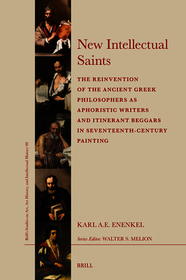
New Intellectual Saints
The Reinvention of the Ancient Greek Philosophers as Aphoristic Writers and Itinerant Beggars in Seventeenth-Century Painting
Series: Brill?s Studies on Art, Art History, and Intellectual History; 88;
- Publisher's listprice EUR 181.00
-
70 698 Ft (67 332 Ft + 5% VAT)
The price is estimated because at the time of ordering we do not know what conversion rates will apply to HUF / product currency when the book arrives. In case HUF is weaker, the price increases slightly, in case HUF is stronger, the price goes lower slightly.
- Discount 5% (cc. 3 534 Ft off)
- Discounted price 67 164 Ft (63 965 Ft + 5% VAT)
Subcribe now and take benefit of a favourable price.
Subscribe
70 698 Ft

Availability
Not yet published.
Why don't you give exact delivery time?
Delivery time is estimated on our previous experiences. We give estimations only, because we order from outside Hungary, and the delivery time mainly depends on how quickly the publisher supplies the book. Faster or slower deliveries both happen, but we do our best to supply as quickly as possible.
Product details:
- Edition number 1
- Publisher Brill
- Date of Publication 7 October 2026
- ISBN 9789004751774
- Binding Hardback
- No. of pages430 pages
- Size 235x155x27 mm
- Weight 1 g
- Language English 700
Categories
Long description:
This book explores the reinvention of the Greek philosophers by seventeenth-century painters who transformed them into saintly icons of the intellectual life. Fundamental is the novel conception of these philosophers as itinerant beggars and dedicated writers of aphorisms. Drawing heavily on Diogenes Laertius, Erasmus and other author-collectors of apothegms, the painters create living and above all speaking images of the philosophers which were meant to trigger reflection on the core issues of human existence. Above all, these painted philosophers are shown to be men of paper, who used it to read, write, and think, and who engaged bodily and spiritually with the paper codex.
More
