

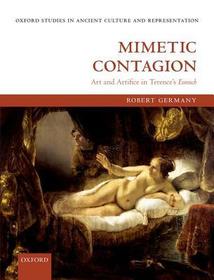
Mimetic Contagion
Art and Artifice in Terence's Eunuch
Series: Oxford Studies in Ancient Culture & Representation;
- Publisher's listprice GBP 107.50
-
48 536 Ft (46 225 Ft + 5% VAT)
The price is estimated because at the time of ordering we do not know what conversion rates will apply to HUF / product currency when the book arrives. In case HUF is weaker, the price increases slightly, in case HUF is stronger, the price goes lower slightly.
- Discount 10% (cc. 4 853 Ft off)
- Discounted price 43 683 Ft (41 603 Ft + 5% VAT)
Subcribe now and take benefit of a favourable price.
Subscribe
48 536 Ft

Availability
printed on demand
Why don't you give exact delivery time?
Delivery time is estimated on our previous experiences. We give estimations only, because we order from outside Hungary, and the delivery time mainly depends on how quickly the publisher supplies the book. Faster or slower deliveries both happen, but we do our best to supply as quickly as possible.
Product details:
- Publisher OUP Oxford
- Date of Publication 27 October 2016
- ISBN 9780198738732
- Binding Hardback
- No. of pages212 pages
- Size 255x198x16 mm
- Weight 598 g
- Language English 0
Categories
Short description:
This volume considers the phenomenon of mimetic contagion, whereby works of art draw viewers into direct imitation of themselves, and how it operates within specific historical contexts. Terence's Eunuch is used as a case study, situating the motif within the peculiarities of mid-second-century BC Rome and its anxieties about the power of art.
MoreLong description:
When we are confronted with a work of art, what is its effect on us? In contrast to post-Enlightenment conceptions, which tend to restrict themselves to aesthetic or discursive responses, the ancient Greeks and Romans often conceived works of art as having a more dynamic effect on their viewers, inspiring them to direct imitation of what they saw represented. This notion of 'mimetic contagion' was a persistent and widespread mode of framing response to art across the ancient world, discernible in both popular and elevated cultural forms, yet deployed differently in various historical contexts; it is only under the specificity of a particular cultural moment's concerns that it becomes most useful as a lens for understanding how that culture is attempting to negotiate the problems of representation.
After framing the phenomenon in terms general enough to be applicable across many periods, literary genres, and artistic media, this volume takes a particular literary work, Terence's Eunuch, as a starting point, both as a vivid example of this extensive pattern, and as a case study situating use of the motif within the peculiarities of a particular historical moment, in this case mid-second-century BC Rome and its anxieties about the power of art. One of the features of mimetic contagion frequently noted in this study is its capacity to render the operation of a particular work of art an emblem for the effect of representation more generally, and this is certainly the case in the Eunuch, whereby the painting at the centre of the play functions as a metatheatrical figure for the dynamics of mimesis throughout, illustrating how the concept may function as the key to a particular literary work. Although mimetic contagion is only one available Greco-Roman strategy for understanding the power of art, by offering an extended reading of a single work of literature through this lens, this volume demonstrates what ramifications closer attention to it might have for modern readers and literary criticism.
This impeccably produced book is unpretentiously erudite; as the saying goes, much more than the sum of its (very many, ancient and modern) parts, impressively documented and arranged: literary-philological analysis and performance criticism, art-historical and anthropological inquiry, sociocultural and intellectual history. Germany regularly deploys critical theory pedagogically judiciously, painlessly introducing uninitiated readers to Benjamin, Foucault, Frazer, Gell, and Irigaray, to name some. Ultimately, Germany's sophisticated and dense analysis, masterfully delivered in clear, serene prose is a pleasure to read. All along, the book is very polemical-indeed fundamentally polemical-though about as honestly and pertinently as polemics can be. ... This book, a giant step forward in Terentian scholarship, is in every respect his worthy legacy
Table of Contents:
Frontispiece
Acknowledgements
Introduction
Judging Chaerea: the Role of the Painting
Quickening Images: Mimetic Contagion in Cultic and Erotic Art
Lifelike Likeness: Mimetic Contagion in the Philosophical Tradition
Mimetic Contagion in Terence's Rome
Mimic Rape: Genre Switching and Role Confusion
The Poetics of Contamination
Epilogue
Bibliography
Index

