

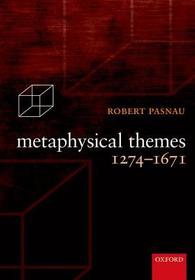
Metaphysical Themes 1274-1671
- Publisher's listprice GBP 52.00
-
23 478 Ft (22 360 Ft + 5% VAT)
The price is estimated because at the time of ordering we do not know what conversion rates will apply to HUF / product currency when the book arrives. In case HUF is weaker, the price increases slightly, in case HUF is stronger, the price goes lower slightly.
- Discount 10% (cc. 2 348 Ft off)
- Discounted price 21 130 Ft (20 124 Ft + 5% VAT)
Subcribe now and take benefit of a favourable price.
Subscribe
23 478 Ft

Availability
printed on demand
Why don't you give exact delivery time?
Delivery time is estimated on our previous experiences. We give estimations only, because we order from outside Hungary, and the delivery time mainly depends on how quickly the publisher supplies the book. Faster or slower deliveries both happen, but we do our best to supply as quickly as possible.
Product details:
- Publisher OUP Oxford
- Date of Publication 7 February 2013
- ISBN 9780199674480
- Binding Paperback
- No. of pages810 pages
- Size 246x170x43 mm
- Weight 1288 g
- Language English 0
Categories
Short description:
Robert Pasnau tells a continuous story about the development of philosophy from the late Middle Ages into the early modern era of the seventeenth century. The focus is questions in metaphysics concerning the nature of matter and the structure of the material world.
MoreLong description:
Robert Pasnau traces the developments of metaphysical thinking through four rich but for the most part neglected centuries of philosophy, running from the thirteenth century through to the seventeenth. At no period in the history of philosophy, other than perhaps our own, have metaphysical problems received the sort of sustained attention they received during the later Middle Ages, and never has a whole philosophical tradition come crashing down as quickly and completely as did scholastic philosophy in the seventeenth century. The thirty chapters work through various fundamental metaphysical issues, sometimes focusing more on scholastic thought, sometimes on the seventeenth century. Pasnau begins with the first challenges to the classical scholasticism of Bonaventure and Thomas Aquinas, runs through prominent figures like John Duns Scotus and William Ockham, and ends in the seventeenth century, with the end of the first stage of developments in post-scholastic philosophy: on the continent, with Descartes and Gassendi, and in England, with Boyle and Locke.
Readers with a keen interest in metaphysics and a doughty historical stamina will find Pasnau's book rewarding.
Table of Contents:
Introduction
I. Matter
Substratum
Theories of Prime Matter
Matter and Extension
Philosophiae Perenne
II. Substance
Subjects and Substances
The Veiled Subject
Cartesian Substances
Lockean Substances
III. Accidents
Real Accidents
Inherence
Categories
Modes
IV. Extension
Quantity and Extension
Extension and Impenetrability
Mind and Extension
Location
Entia Successiva
V. Quality
Real Qualities
Heresy and Novelty
Primary Qualities
Secondary Qualities
Powers and Dispositions
VI. Unity and Identity
Substantial Form
Unity and Dualism
Parts and Wholes
Real Essences
Permanence and Corruption
Identity over Time
Locke's Nominal Substances
Tables of Authors
Bibliography of Primary Sources
Bibliography of Secondary Sources

