

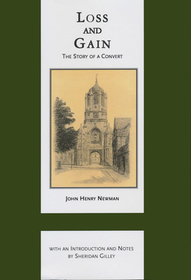
Loss and Gain
The Story of a Convert
Series: Works of Cardinal Newman: Birmingham Oratory Millennium Edition;
- Publisher's listprice GBP 40.00
-
18 060 Ft (17 200 Ft + 5% VAT)
The price is estimated because at the time of ordering we do not know what conversion rates will apply to HUF / product currency when the book arrives. In case HUF is weaker, the price increases slightly, in case HUF is stronger, the price goes lower slightly.
- Discount 10% (cc. 1 806 Ft off)
- Discounted price 16 254 Ft (15 480 Ft + 5% VAT)
Subcribe now and take benefit of a favourable price.
Subscribe
18 060 Ft

Availability
Uncertain availability. Please turn to our customer service.
Why don't you give exact delivery time?
Delivery time is estimated on our previous experiences. We give estimations only, because we order from outside Hungary, and the delivery time mainly depends on how quickly the publisher supplies the book. Faster or slower deliveries both happen, but we do our best to supply as quickly as possible.
Product details:
- Edition number Reprint
- Publisher University of Notre Dame Press
- Date of Publication 15 May 2015
- Number of Volumes Print PDF
- ISBN 9780268036133
- Binding Hardback
- No. of pages277 pages
- Size 203x127x32 mm
- Weight 648 g
- Language English 0
Categories
Long description:
"
It may seem surprising to discover that a Catholic cardinal was a novelist, and Newman advanced this as an obstacle to his own canonization: ""Saints are not literary men,"" he wrote, ""they do not love the classics, they do not write Tales."" He was only fit ""to black the saints' shoes—if Saint Philip uses blacking, in heaven.""
The background to Loss and Gain was a controversial one. Newman wrote the book in part to provide a title for publication by James Burns, of the later celebrated firm of Burns and Oates, who had lost his stable of Anglican authors by converting in 1847 to Catholicism.
An understanding of the novel requires some knowledge of its Oxford background, of the university setting, which was compared in the fierceness of its loyalties by Newman's friend Richard Church to a Renaissance Italian city, implying an assassin with a stiletto round every corner. In short, there is a sense in which, in spite of its fictional character, Loss and Gain is a work of controversy, full of echoes of old battles over whether the Thirty-Nine Articles of Religion and the Book of Common Prayer should be interpreted in a ""Catholic"" or a ""Protestant"" sense. It is a response, like Newman's other works, to a challenge, and so its hero, Charles Reding, as a student in Oxford, passes through the hands of the representatives of a number of Anglican parties and schools of theology before resolving his doubts in Rome.
" More
