

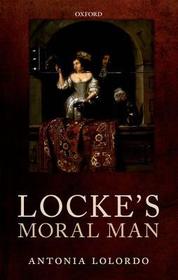
Locke's Moral Man
- Publisher's listprice GBP 71.00
-
32 056 Ft (30 530 Ft + 5% VAT)
The price is estimated because at the time of ordering we do not know what conversion rates will apply to HUF / product currency when the book arrives. In case HUF is weaker, the price increases slightly, in case HUF is stronger, the price goes lower slightly.
- Discount 10% (cc. 3 206 Ft off)
- Discounted price 28 851 Ft (27 477 Ft + 5% VAT)
Subcribe now and take benefit of a favourable price.
Subscribe
32 056 Ft

Availability
printed on demand
Why don't you give exact delivery time?
Delivery time is estimated on our previous experiences. We give estimations only, because we order from outside Hungary, and the delivery time mainly depends on how quickly the publisher supplies the book. Faster or slower deliveries both happen, but we do our best to supply as quickly as possible.
Product details:
- Publisher OUP Oxford
- Date of Publication 4 October 2012
- ISBN 9780199652778
- Binding Hardback
- No. of pages154 pages
- Size 220x154x14 mm
- Weight 322 g
- Language English 0
Categories
Short description:
Antonia Lolordo presents an original interpretation of John Locke's metaphysics of moral agency, in which to be a moral agent is simply to be free, rational, and a person. Her account bears on Locke's metaphysics and political theory, and helps us understand his wider philosophical project and his accounts of liberty, personhood, and rationality.
MoreLong description:
Antonia Lolordo presents an original interpretation of John Locke's conception of moral agency--one that has implications both for his metaphysics and for the foundations of his political theory. Locke denies that species boundaries exist independently of human convention, holds that the human mind may be either an immaterial substance or a material one to which God has superadded the power of thought, and insists that animals possess the ability to perceive, will, and even reason--indeed, in some cases to reason better than humans. Thus, he eliminates any sharp distinction between humans and the rest of the animal kingdom. However, in his ethical and political work Locke assumes that there is a sharp distinction between moral agents and other beings. He thus needs to be able to delineate the set of moral agents precisely, without relying on the sort of metaphysical and physical facts his predecessors appealed to. Lolordo argues that for Locke, to be a moral agent is simply to be free, rational, and a person. Interpreting the Lockean metaphysics of moral agency in this way helps us to understand both Locke's over-arching philosophical project and the details of his accounts of liberty, personhood, and rationality.
fascinating . . . Her picture of Locke's avoidance of metaphysics is, I think, an extremely significant one . . . LoLordo has written a book that is a solid and well-supported addition to the literature, and one that will certainly be provocative.
Table of Contents:
Introduction
Liberty
Personality
Rationality
Conclusion
Bibliography
Index

