

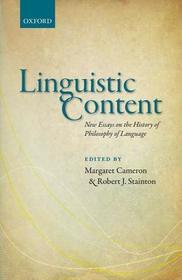
Linguistic Content
New Essays on the History of Philosophy of Language
- Publisher's listprice GBP 82.00
-
39 175 Ft (37 310 Ft + 5% VAT)
The price is estimated because at the time of ordering we do not know what conversion rates will apply to HUF / product currency when the book arrives. In case HUF is weaker, the price increases slightly, in case HUF is stronger, the price goes lower slightly.
- Discount 10% (cc. 3 918 Ft off)
- Discounted price 35 258 Ft (33 579 Ft + 5% VAT)
Subcribe now and take benefit of a favourable price.
Subscribe
39 175 Ft

Availability
Uncertain availability. Please turn to our customer service.
Why don't you give exact delivery time?
Delivery time is estimated on our previous experiences. We give estimations only, because we order from outside Hungary, and the delivery time mainly depends on how quickly the publisher supplies the book. Faster or slower deliveries both happen, but we do our best to supply as quickly as possible.
Product details:
- Publisher OUP Oxford
- Date of Publication 19 March 2015
- ISBN 9780198732495
- Binding Hardback
- No. of pages282 pages
- Size 240x162x22 mm
- Weight 582 g
- Language English 0
Categories
Short description:
This volume explores the rich history of philosophy of language in the Western tradition, from Plato and Aristotle to the twentieth century. A team of leading experts focus in particular on key metaphysical debates about linguistic content, including questions of ontological status and metaphysical grounding.
MoreLong description:
Philosophy of language has a rich and varied history stretching back to the Ancient Greeks. Twelve specially written essays explore this richness, from Plato and Aristotle, through the Stoics, to medieval thinkers, both Islamic and Christian; from the Renaissance and the early modern period, all the way up to the twentieth Century. Among the many topics that arise across this 2500-year trajectory are metaphysical questions about linguistic content. A first focal point of the volume is the issue of which broad ontological family linguistic contents belong to. Are linguistic contents mental ideas, physical particulars, abstract Forms, social practices, or something else again? And do different sorts of linguistic contents belong to different ontological categories-e.g., might it be that names stand for ideas, whereas logical terms stand for mental processes? The second focal point is the metaphysical grounding of linguistic content: that is, in virtue of what more basic facts do content facts obtain? Do words mean what they do because of natural resemblances? Because of causal relations? Because of arbitrary conventional usage? Or because of some combination of the above?
I recommend this volume and hope that it will spur further research into what has been, until very recently, the invisible history of the philosophy language.
Table of Contents:
Introduction
Method, Meaning, and Ontology in Plato's Philosophy of Language
Names, Verbs, and Sentences in Ancient Greek Philosophy
On what is said: the Stoics and Peter Abelard
Philosophy of Language in the Medieval Arabic Tradition
Those 'funny words': medieval theories of syncategorematic terms
Semantic Content in Aquinas and Ockham
Meaning and Linguistic Usage in Renaissance Humanism: The case of Valla
Medieval Theories of Signification to John Locke
Locke on the Names of Modes
Herder's Doctrine of Meaning as Use
Thomas Reid on Language
'Meaning in Action': Anton Marty's Pragmatic Semantics

