

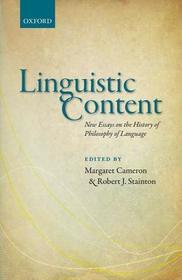
Linguistic Content
New Essays on the History of Philosophy of Language
-
10% KEDVEZMÉNY?
- A kedvezmény csak az 'Értesítés a kedvenc témákról' hírlevelünk címzettjeinek rendeléseire érvényes.
- Kiadói listaár GBP 82.00
-
39 175 Ft (37 310 Ft + 5% áfa)
Az ár azért becsült, mert a rendelés pillanatában nem lehet pontosan tudni, hogy a beérkezéskor milyen lesz a forint árfolyama az adott termék eredeti devizájához képest. Ha a forint romlana, kissé többet, ha javulna, kissé kevesebbet kell majd fizetnie.
- Kedvezmény(ek) 10% (cc. 3 918 Ft off)
- Kedvezményes ár 35 258 Ft (33 579 Ft + 5% áfa)
Iratkozzon fel most és részesüljön kedvezőbb árainkból!
Feliratkozom
39 175 Ft

Beszerezhetőség
Bizonytalan a beszerezhetőség. Érdemes még egyszer keresni szerzővel és címmel. Ha nem talál másik, kapható kiadást, forduljon ügyfélszolgálatunkhoz!
Why don't you give exact delivery time?
A beszerzés időigényét az eddigi tapasztalatokra alapozva adjuk meg. Azért becsült, mert a terméket külföldről hozzuk be, így a kiadó kiszolgálásának pillanatnyi gyorsaságától is függ. A megadottnál gyorsabb és lassabb szállítás is elképzelhető, de mindent megteszünk, hogy Ön a lehető leghamarabb jusson hozzá a termékhez.
A termék adatai:
- Kiadó OUP Oxford
- Megjelenés dátuma 2015. március 19.
- ISBN 9780198732495
- Kötéstípus Keménykötés
- Terjedelem282 oldal
- Méret 240x162x22 mm
- Súly 582 g
- Nyelv angol 0
Kategóriák
Rövid leírás:
This volume explores the rich history of philosophy of language in the Western tradition, from Plato and Aristotle to the twentieth century. A team of leading experts focus in particular on key metaphysical debates about linguistic content, including questions of ontological status and metaphysical grounding.
TöbbHosszú leírás:
Philosophy of language has a rich and varied history stretching back to the Ancient Greeks. Twelve specially written essays explore this richness, from Plato and Aristotle, through the Stoics, to medieval thinkers, both Islamic and Christian; from the Renaissance and the early modern period, all the way up to the twentieth Century. Among the many topics that arise across this 2500-year trajectory are metaphysical questions about linguistic content. A first focal point of the volume is the issue of which broad ontological family linguistic contents belong to. Are linguistic contents mental ideas, physical particulars, abstract Forms, social practices, or something else again? And do different sorts of linguistic contents belong to different ontological categories-e.g., might it be that names stand for ideas, whereas logical terms stand for mental processes? The second focal point is the metaphysical grounding of linguistic content: that is, in virtue of what more basic facts do content facts obtain? Do words mean what they do because of natural resemblances? Because of causal relations? Because of arbitrary conventional usage? Or because of some combination of the above?
I recommend this volume and hope that it will spur further research into what has been, until very recently, the invisible history of the philosophy language.
Tartalomjegyzék:
Introduction
Method, Meaning, and Ontology in Plato's Philosophy of Language
Names, Verbs, and Sentences in Ancient Greek Philosophy
On what is said: the Stoics and Peter Abelard
Philosophy of Language in the Medieval Arabic Tradition
Those 'funny words': medieval theories of syncategorematic terms
Semantic Content in Aquinas and Ockham
Meaning and Linguistic Usage in Renaissance Humanism: The case of Valla
Medieval Theories of Signification to John Locke
Locke on the Names of Modes
Herder's Doctrine of Meaning as Use
Thomas Reid on Language
'Meaning in Action': Anton Marty's Pragmatic Semantics

