

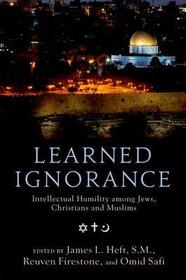
Learned Ignorance
Intellectual Humility among Jews, Christians and Muslims
- Publisher's listprice GBP 44.99
-
21 493 Ft (20 470 Ft + 5% VAT)
The price is estimated because at the time of ordering we do not know what conversion rates will apply to HUF / product currency when the book arrives. In case HUF is weaker, the price increases slightly, in case HUF is stronger, the price goes lower slightly.
- Discount 10% (cc. 2 149 Ft off)
- Discounted price 19 344 Ft (18 423 Ft + 5% VAT)
Subcribe now and take benefit of a favourable price.
Subscribe
21 493 Ft

Availability
printed on demand
Why don't you give exact delivery time?
Delivery time is estimated on our previous experiences. We give estimations only, because we order from outside Hungary, and the delivery time mainly depends on how quickly the publisher supplies the book. Faster or slower deliveries both happen, but we do our best to supply as quickly as possible.
Product details:
- Publisher OUP USA
- Date of Publication 4 August 2011
- ISBN 9780199769315
- Binding Paperback
- No. of pages360 pages
- Size 231x155x22 mm
- Weight 476 g
- Language English 0
Categories
Short description:
Constructive interreligious dialogue is only a recent phenomenon. At the beginning of the twenty-first century, many branches of Christianity, not least the Catholic Church, are engaged in a world-wide constructive dialogue with Jews and also with Muslims, made all the more necessary by the terrorist attacks of September 11. The Institute for Advanced Catholic Studies brought together an international group of sixteen Jewish, Catholic and Muslim scholars to carry on an important theological exploration of the theme of ''learned ignorance.''
MoreLong description:
Constructive interreligious dialogue is only a recent phenomenon. Until the nineteenth century, most dialogue among believers was carried on as a debate aimed either to disprove the claims of the other, or to convert the other to one's own tradition. At the end of the nineteenth century, Protestant Christian missionaries of different denominations had created such a cacophony amongst themselves in the mission fields that they decided that it would be best if they could begin to overcome their own differences instead of confusing and even scandalizing the people whom they were trying to convert. By the middle of the twentieth century, the horrors of the Holocaust compelled Christians, especially mainline Protestants and Catholics, to enter into a serious dialogue with Jews, one of the consequences of which was the removal of claims by Christians to have replaced Judaism, and revising text books that communicated that message to Christian believers.
Now, at the beginning of the twenty-first century, many branches of Christianity, not least the Catholic Church, are engaged in a world-wide constructive dialogue with Muslims, made all the more necessary by the terrorist attacks of September 11. In these new conversations, Muslim religious leaders took an important initiative when they sent their document,''A Common Word Between Us,'' to all Christians in the West. It is an extraordinary document, for it makes a theological argument (various Christians in the West, including officials at the Vatican, have claimed that a ''theological conversation'' with Muslims is not possible) based on texts drawn from the Hebrew Bible, the New Testament and the Qur'an, that Jewish, Christian, and Muslim believers share the God-given obligation to love God and each other in peace and justice.
The Institute for Advanced Catholic Studies brought together an international group of sixteen Jewish, Catholic, and Muslim scholars to carry on an important theological exploration of the theme of ''learned ignorance.''
This explicitly theological and exceptionally engaging collection of scholarly essays represents trilateral dialogue in its most refined yet attractively challenging form. Here Jewish, Christian and Muslim authors address core mysteries of their faiths that bear consequentially on the whole 'Abrahamic' monotheistic tradition. Their compelling unity of purpose is to unravel, by thinking pluralistically to the limits of knowledge beyond specific questions, that condition of wonderment and intellectual humility before ineffable truth.
Table of Contents:
1. Preface James L. Heft
2. Introduction James L. Heft
Part I: Learned Ignorance and Interreligious Dialogue
3. Some Requisites for Interfaith Dialogue David B. Burrell
4. Learned Ignorance and Faithful Interpretation of the Qur'an in Nicholas of Cusa Pim Valkenberg
5. ''Seeing the Sounds'': Intellectual Humility and the Process of Dialogue Michael Signer
6. Finding Common Ground: ''Mutual Knowing,'' Moderation, and the Fostering of Religious Pluralism Asma Afsaruddin
Part II: Must Particularity Be Exclusive?
7. Humble Infallibility James L. Heft
8. Chosenness and the Exclusivity of Truth: What does it Mean to be ''Chosen''? Reuven Firestone
9. The Belief in the Incarnation of God: Source or Religious Humility or Cause of Theological Pride? Oliver-Thomas Venard
10. Supernatural Israel: Obstacles to Theological Humility in Jewish Tradition Shira L. Lander
11. Arrogance and Humility: a Quranic Perspective Afra Jalabi
Part III: Violence, Apologies and Conflict
12. After Augustine: Humility and the Search for God in Historical Memory Elizabeth Groppe
13. Apology, Regret and Intellectual Humility: An Interreligious Consideration Michael B. McGarry
14. Islamic Theological Perspectives on Intellectual Humility and the Conditioning of Interfaith Dialogue Mustafa Abu-sway
Part IV: Religious Pluralism
15. A Meditation on Intellectual Humility: A Fusion of Epistemic Ignorance and Covenantal Certainty Stanislaw Krajewski
16. Saving Dominus Jesus Daniel Madigan
17. Between Tradition and Reform: The Pre-modern Sufism and the Iranian Reform Movement Omid Safi
18. Epilogue: The Purpose of Interreligious Dialogue James L. Heft, Reuven Firestone, and Omid Safi
Index

