

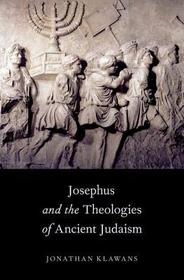
Josephus and the Theologies of Ancient Judaism
- Publisher's listprice GBP 107.50
-
48 536 Ft (46 225 Ft + 5% VAT)
The price is estimated because at the time of ordering we do not know what conversion rates will apply to HUF / product currency when the book arrives. In case HUF is weaker, the price increases slightly, in case HUF is stronger, the price goes lower slightly.
- Discount 10% (cc. 4 853 Ft off)
- Discounted price 43 683 Ft (41 603 Ft + 5% VAT)
Subcribe now and take benefit of a favourable price.
Subscribe
48 536 Ft

Availability
printed on demand
Why don't you give exact delivery time?
Delivery time is estimated on our previous experiences. We give estimations only, because we order from outside Hungary, and the delivery time mainly depends on how quickly the publisher supplies the book. Faster or slower deliveries both happen, but we do our best to supply as quickly as possible.
Product details:
- Publisher OUP USA
- Date of Publication 8 November 2012
- ISBN 9780199928613
- Binding Hardback
- No. of pages400 pages
- Size 163x239x33 mm
- Weight 814 g
- Language English 0
Categories
Short description:
Jonathan Klawans's Josephus and the Theologies of Ancient Judaism cuts against the grain of rabbinic studies to establish the value of Flavius Josephus's descriptions of the religious ideas of various Jewish sects for reconstructing the world of ideas (the theologies) at play in early Judaism. It is intended as a response to the prevalent approach to the study of early Judaism, which focuses on legal or halakhic issues rather than matters of religious belief.
MoreLong description:
Jonathan Klawans's Josephus and the Theologies of Ancient Judaism cuts against the grain of rabbinic studies to establish the value of Flavius Josephus's descriptions of the religious ideas of various Jewish sects for reconstructing the world of ideas (the theologies) at play in early Judaism. It is intended as a response to the prevalent approach to the study of early Judaism, which focuses on legal or halakhic issues rather than matters of religious belief. Klawans illuminates Josephus's description of early Jewish sects (the Pharisees, Sadducees, and Essenes) against distinct bodies of literature including Rabbinic sources, Qumran scrolls, and wisdom literature, especially Ben Sira. He is also concerned to show how various beliefs operate in connection with historical events, from the Hasmonean rebellion to after the destruction of the Temple. He demonstrates, for example, that beliefs about resurrection may have been less a reaction to social or historical circumstances than scholars have claimed and that the destruction of the Temple in 70 CE may not have created such a severe theological crises as previously thought. He provides alternative explanations for beliefs about the afterlife and shows that the reaction to the Temple's loss may have been more easily dealt with in terms of preexisting theological ideas and analogies. In each case, Klawans brings to the forefront Josephus's own views about these matters and shows how they are important for a more balanced assessment of the history of early Judaism.
Klawan's arguments are worth reading, whether they bring us to give up long-held opinions or only to re-examine their foundations.
Table of Contents:
List of Abbreviations
Note on Translations and Editions
Chapter 1: Theology, Josephus, and Understandings of Ancient Judaism
Chapter 2: Fate, Free Will and Ancient Jewish Types of Compatibilism
Chapter 3: Afterlives and Noble Deaths
Chapter 4: Torah, Tradition, and Innovation
Chapter 5: Josephus and Judaism after 70 CE
Conclusion
Appendix: Essenes and Resurrection according to Hippolytus
Notes
Bibliography
Index

