

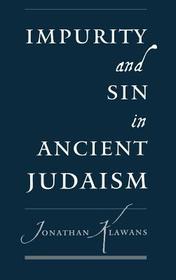
Impurity and Sin in Ancient Judaism
- Publisher's listprice GBP 88.00
-
42 042 Ft (40 040 Ft + 5% VAT)
The price is estimated because at the time of ordering we do not know what conversion rates will apply to HUF / product currency when the book arrives. In case HUF is weaker, the price increases slightly, in case HUF is stronger, the price goes lower slightly.
- Discount 10% (cc. 4 204 Ft off)
- Discounted price 37 838 Ft (36 036 Ft + 5% VAT)
Subcribe now and take benefit of a favourable price.
Subscribe
42 042 Ft

Availability
printed on demand
Why don't you give exact delivery time?
Delivery time is estimated on our previous experiences. We give estimations only, because we order from outside Hungary, and the delivery time mainly depends on how quickly the publisher supplies the book. Faster or slower deliveries both happen, but we do our best to supply as quickly as possible.
Product details:
- Publisher OUP USA
- Date of Publication 14 December 2000
- ISBN 9780195132908
- Binding Hardback
- No. of pages256 pages
- Size 229x152x19 mm
- Weight 553 g
- Language English 0
Categories
Short description:
This book examines the ways in which two distinct biblical conceptions of impurity - 'ritual' and 'moral' - were interpreted in the Hebrew Bible, the Dead Sea Scrolls, rabbinic literature, and the New Testament. In examining the evolution of ancient Jewish attitudes towards sin and defilement, Klawans sheds light on a fascinating but previously neglected topic.
MoreLong description:
Much has been written about ritual impurity in ancient Judaism, but the question of how the ancient Jews understood the relationship between defilement and sin has largely been ignored. This book offers the first systematic exploration of the important topic to be published in the last seventy years. Jonathan Klawans takes the results of current research on the Hebrew Bible and applies them to early Jewish and Christian groups. The Bible, he shows, considers the moral impurity generated by sin to be entirely distinct from (but no less real than) the ritual impurity generated by bodily function such as menstruation. Klawans then traces the relationship between ritual and moral impurity from early Jewish sects through the New Testament and the theology of Saint Paul and shows how Christian theology arrived at the point where the need for ritual purity was entirely rejected.
Will shape the ways in which scholars view and discuss the role of purity in early Judaism and Christianity ... makes a distinct and complementary contribution to the study of purity in ancient Jewish and Christian communities

