

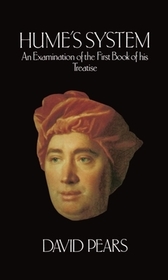
Hume's System
An Examination of the First Book of his Treatise
- Publisher's listprice GBP 112.50
-
50 793 Ft (48 375 Ft + 5% VAT)
The price is estimated because at the time of ordering we do not know what conversion rates will apply to HUF / product currency when the book arrives. In case HUF is weaker, the price increases slightly, in case HUF is stronger, the price goes lower slightly.
- Discount 10% (cc. 5 079 Ft off)
- Discounted price 45 714 Ft (43 538 Ft + 5% VAT)
Subcribe now and take benefit of a favourable price.
Subscribe
50 793 Ft

Availability
printed on demand
Why don't you give exact delivery time?
Delivery time is estimated on our previous experiences. We give estimations only, because we order from outside Hungary, and the delivery time mainly depends on how quickly the publisher supplies the book. Faster or slower deliveries both happen, but we do our best to supply as quickly as possible.
Product details:
- Publisher OUP Oxford
- Date of Publication 3 January 1991
- ISBN 9780198751007
- Binding Hardback
- No. of pages216 pages
- Size 224x145x19 mm
- Weight 415 g
- Language English 0
Categories
Short description:
This lucid study of the foundation of Hume's system differs from other books on the subject by steering a middle course between two popular but extreme views: that Hume's relies exclusively on a theory of meaning and that he relies exclusively on a theory of truth and evidence. Unlike other studies, too, Pears concentrates on the first book of Hume's Treatise, which is where his ideas were presented in a fresh and undiluted form. Hume is essential reading for all students of philosophy, and the book covers several topics which are encountered on a philosophy course (see market).
MoreLong description:
In this book, Professor Pears examines the foundations of Hume's system as laid down in the first book of his Treatise, where his ideas are presented in their first fresh and undiluted form. The author steers a middle course between the two extreme views adopted in recent writings on Hume: that he relies exclusively on a theory of meaning, or that he relies exclusively on a theory of truth and evidence. Professor Pears argues that Hume's theory of ideas serves both functions, and he examines in detail its application to three difficult problems: causation, personal identity, and sense-perception. Hume's solutions are shown not to be theories which can be given a place in a standard classification of philosophical theories, but rather to depend upon a subtle form of naturalism not altogether unlike Wittgenstein's naturalism.
characteristically lucid study
Table of Contents:
I: Hume's General Theory of Mind: A General Account of Hume's Theory of Mind; The Derivation of Ideas from Impressions; Memory; Belief and Existence; II: The Application of the Theory of Mind to Three Problems: Causation Personal Identity and Perception: Causation: The Evidence and its First Effect on Us; Causation: The Gap Between Evidence and Belief; Causation: The Second Effect of the Evidence; Personal Identity: The Problem an Hume's Rejection of Current Solutions; Personal Identity: Hume's solution and his later Recantation; Sense-Perception: Hume's Assessment of the Problem and his Strategy for Eliminating Current Solutions; Sense Perception: Hume's Heroic Solution
More
