

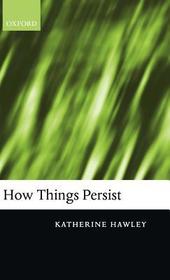
How Things Persist
- Publisher's listprice GBP 125.00
-
56 437 Ft (53 750 Ft + 5% VAT)
The price is estimated because at the time of ordering we do not know what conversion rates will apply to HUF / product currency when the book arrives. In case HUF is weaker, the price increases slightly, in case HUF is stronger, the price goes lower slightly.
- Discount 10% (cc. 5 644 Ft off)
- Discounted price 50 794 Ft (48 375 Ft + 5% VAT)
Subcribe now and take benefit of a favourable price.
Subscribe
56 437 Ft

Availability
printed on demand
Why don't you give exact delivery time?
Delivery time is estimated on our previous experiences. We give estimations only, because we order from outside Hungary, and the delivery time mainly depends on how quickly the publisher supplies the book. Faster or slower deliveries both happen, but we do our best to supply as quickly as possible.
Product details:
- Publisher OUP Oxford
- Date of Publication 3 January 2002
- ISBN 9780199249138
- Binding Hardback
- No. of pages232 pages
- Size 224x146x17 mm
- Weight 427 g
- Language English 0
Categories
Short description:
The world is remarkably stable -- amidst the flux, physical objects continue to persist. But how do things persist? Are they spread out through time as they are spread out through space? Or is persistence very different from spatial extension? These ancient metaphysical questions are at the forefront of contemporary debate once more. Katherine Hawley provides a wide-ranging yet accessible study of this key issue. She also makes a major contribution to current debates about change, vagueness, and language.
MoreLong description:
How do things persist? Are material objects spread out through time just as they are spread out through space? Or is temporal persistence quite different from spatial extension? This key question lies at the heart of any metaphysical exploration of the material world, and it plays a crucial part in debates about personal identity and survival. Katherine Hawley explores and compares three theories of persistence -- endurance, perdurance, and stage theories - investigating the ways in which they attempt to account for the world around us. Having provided valuable clarification of its two main rivals, she concludes by advocating stage theory.
Such a basic issue about the nature of the physical world naturally has close ties with other central philosophical problems. How Things Persist includes discussions of change and parthood, of how we refer to material objects at different times, of the doctrine of Humean supervenience, and of the modal features of material things. In particular, it contains new accounts of the nature of worldly vagueness, and of what binds material things together over time, distinguishing the career of a natural object from an arbitrary sequence of events. Each chapter concludes with a reflection about the impact of these metaphysical debates upon questions about our personal identity and survival.
Both students and professional philosophers will find that this wide-ranging study provides ideal access to the lively modern debate about an ancient metaphysical problem.
How Things Persist is a careful and clever defence of stage theory ... the book is not only a worthy defence of a novel ontology, it is also an instructive survey of the metaphysics of material objects in general and the philosophy of persistence in particular.
Table of Contents:
Introduction
Sameness and Difference
Parts and Stages
Sticking Stages Together
Vagueness
Sheer Coincidence?
Modality
Epilogue
Bibliography, Index

