

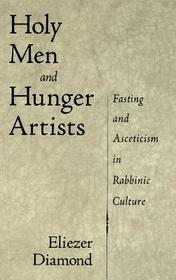
Holy Men and Hunger Artists
Fasting and Asceticism in Rabbinic Culture
- Publisher's listprice GBP 99.00
-
44 698 Ft (42 570 Ft + 5% VAT)
The price is estimated because at the time of ordering we do not know what conversion rates will apply to HUF / product currency when the book arrives. In case HUF is weaker, the price increases slightly, in case HUF is stronger, the price goes lower slightly.
- Discount 10% (cc. 4 469 Ft off)
- Discounted price 40 229 Ft (38 313 Ft + 5% VAT)
Subcribe now and take benefit of a favourable price.
Subscribe
44 698 Ft

Availability
printed on demand
Why don't you give exact delivery time?
Delivery time is estimated on our previous experiences. We give estimations only, because we order from outside Hungary, and the delivery time mainly depends on how quickly the publisher supplies the book. Faster or slower deliveries both happen, but we do our best to supply as quickly as possible.
Product details:
- Publisher OUP Oxford
- Date of Publication 8 January 2004
- ISBN 9780195137507
- Binding Hardback
- No. of pages240 pages
- Size 228x177x23 mm
- Weight 567 g
- Language English 0
Categories
Short description:
The existence of ascetic elements within rabbinic Judaism has generally been either overlooked or actually denied. Diamond shows that rabbinic asceticism does indeed exist. This asceticism is mainly secondary, rather than primary, in that the rabbis place no value on self-denial in and of itself, but rather require of themselves the virtual abandonment of familial, social, and economic life in favour of an absolute commitment to the study of the Torah. He also notes that this asceticism dovetails with the rabbinic theology of sin and punishment, which encourages delaying gratification in this world in the hopes of a greater reward in the next.
MoreLong description:
The existence of ascetic elements within rabbinic Judaism has generally been either overlooked or actually denied. This is in part because asceticism is not commonly identified with celibacy, whereas the rabbis emphasized sexuality as a positive good. In addition, argues Eliezer Diamond, it serves the theological agendas of both Jewish and Christian scholars to characterise Judaism as non- or anti-ascetic. In fact, however, Diamond shows that rabbinic asceticism does indeed exist. This asceticism is secondary, rather than primary, in that the rabbis place no value on self-denial in and of itself, but rather require themselves the virtual abandonment of familial, social, and economic life in favour of an absolute commitment to the study of the Torah. It is an asceticism of neglect, rather than negation. One form of asceticism in particular - fasting - became increasingly popular in the wake of the destruction of the second temple. He traces this to the need to mourn the temple's devastation but also to the cessation of temple -related rituals. Diamond shows that fasting was seen as a substitute for these rituals when the Temple was destroyed.
an untypical but revealing book

