

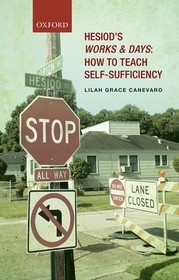
Hesiod's Works and Days
How to Teach Self-Sufficiency
- Publisher's listprice GBP 115.00
-
51 922 Ft (49 450 Ft + 5% VAT)
The price is estimated because at the time of ordering we do not know what conversion rates will apply to HUF / product currency when the book arrives. In case HUF is weaker, the price increases slightly, in case HUF is stronger, the price goes lower slightly.
- Discount 10% (cc. 5 192 Ft off)
- Discounted price 46 730 Ft (44 505 Ft + 5% VAT)
Subcribe now and take benefit of a favourable price.
Subscribe
51 922 Ft

Availability
printed on demand
Why don't you give exact delivery time?
Delivery time is estimated on our previous experiences. We give estimations only, because we order from outside Hungary, and the delivery time mainly depends on how quickly the publisher supplies the book. Faster or slower deliveries both happen, but we do our best to supply as quickly as possible.
Product details:
- Publisher OUP Oxford
- Date of Publication 16 April 2015
- ISBN 9780198729549
- Binding Hardback
- No. of pages284 pages
- Size 221x141x25 mm
- Weight 476 g
- Language English 0
Categories
Short description:
Hesiod's Works and Days was often performed in its entirety, but was also relentlessly excerpted, quoted, and reapplied. This volume situates the poem within these two modes of reading and argues that the text itself sustains both treatments, advocating not blind adherence to Hesiod's teachings but thinking for oneself and working for one's lesson.
MoreLong description:
Greek poet Hesiod's canonical archaic text, the Works and Days, was performed in its entirety, but was also relentlessly excerpted, quoted, and reapplied. In this volume, Lilah Grace Canevaro situates the poem within these two modes of reading and argues that the text itself, through Hesiod's complex mechanism of rendering elements detachable while tethering them to their context for the purposes of the poem, sustains both treatments. One of the poem's difficulties is that Hesiod gives remarkably little advice on how to negotiate these different modes of reading. Canevaro considers the didactic methods employed by Hesiod from two perspectives: in terms of the gaps he leaves, and of how he challenges his audience to fill them. She argues that Hesiod's reticence is linked to the high value he places on self-sufficiency, which creates a productive tension with the didactic thrust of the poem as teaching always involves a relationship of exchange and, at least up to a point, reliance and trust. Hesiod negotiates this potential contradiction by advocating not blind adherence to his teachings but thinking for oneself and working for one's lesson.
Exploring key issues such as gender and genre, and persona and performance, this volume places this important poem within a wider context, revealing how it draws on and contributes to a tradition of usefulness.
Canevaro makes an important contribution to the discussion. She provides a thorough commentary on the Works & Days ... The book is both accessible and of interest to the scholar and the general reader.
Table of Contents:
Preface
Abbreviations
Introduction
Two Reading Traditions: Linear and Excerpting
Two Structuring Strategies: Tethering and Detaching
Two Ideals: Didacticism and Self-Sufficiency
Didactic Methods
Filling the Gaps
Bibliography
Index

