

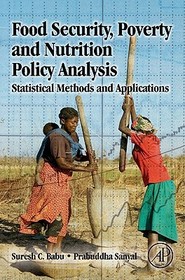
Food Security, Poverty and Nutrition Policy Analysis
Statistical Methods and Applications
- Publisher's listprice EUR 95.95
-
37 478 Ft (35 693 Ft + 5% VAT)
The price is estimated because at the time of ordering we do not know what conversion rates will apply to HUF / product currency when the book arrives. In case HUF is weaker, the price increases slightly, in case HUF is stronger, the price goes lower slightly.
- Discount 10% (cc. 3 748 Ft off)
- Discounted price 33 730 Ft (32 124 Ft + 5% VAT)
Subcribe now and take benefit of a favourable price.
Subscribe
37 478 Ft

Availability
Out of print
Why don't you give exact delivery time?
Delivery time is estimated on our previous experiences. We give estimations only, because we order from outside Hungary, and the delivery time mainly depends on how quickly the publisher supplies the book. Faster or slower deliveries both happen, but we do our best to supply as quickly as possible.
Product details:
- Publisher Elsevier Science
- Date of Publication 8 July 2009
- ISBN 9780123747129
- Binding Hardback
- No. of pages432 pages
- Size 229x152 mm
- Weight 810 g
- Language English 0
Categories
Long description:
Food Security, Poverty and Nutrition Analysis provides essential insights into the evaluative techniques necessary for creating appropriate and effective policies and programs to address these worldwide issues. Food scientists and nutritionists will use this important information, presented in a conceptual framework and through case studies for exploring representative problems, identifying and implementing appropriate methods of measurement and analysis, understanding examples of policy applications, and gaining valuable insight into the multidisciplinary requirements of successful implementation.This book provides core information in a format that provides not only the concept behind the method, but real-world applications giving the reader valuable, practical knowledge.
MoreTable of Contents:
Preface Introduction Section I: Food Security Policy Analysis Introduction to Section I: Food Security Policy Analysis Chapter 1. Introduction to Food Security: Concepts and Measurement Chapter 2. Implications of Technological Change, Post-Harvest Technology and Technology Adoption for Improved Food Security- Application of t- Statistic Chapter 3. Effects of Commercialization of Agriculture (Shift from Traditional Cropto Cash Crop) on Food Consumption and Nutrition- Application of Chi-square Statistic Chapter 4. Effects of Commercialization of Agriculture or Technology Adoption and Gender of Household Head: The Issue, its Importance in Food Security - Application of Cramer's V and Phi Coefficient Chapter 5. Changes in Food Consumption Patterns: The Issue and its Importance toFood Security - Application of One-way ANOVA Chapter 6. Impact of Market Access on Food Security - Application of Factor analysis Section II: Nutrition Policy AnalysisIntroduction to Section II: Nutrition Policy Analysis Chapter 7. Impact of Maternal Education and Care on Preschoolers' Nutrition - Application of Two-way ANOVA Chapter 8. Indicators and Causal Factors of Nutrition - Application of Correlation Analysis Chapter 9. Effects of Individual, Household and Community Indicators on Child's Nutritional Status - Application of Simple Linear Regression Chapter 10. Female education and Community Characteristics as Indicators of Nutritional Status of Children-Application of Multivariate Regression Section III: Special Topics on Poverty, Nutrition, and Food Policy AnalysisIntroduction to Section III: Special Topics on Poverty, Nutrition and Food Policy AnalysisChapter 11. Predicting Child Nutritional Status Using related Socio-economic Variables - Application of Discriminant Function Analysis Chapter 12. Measurement and Determinants of Poverty- Application of Logistic Regression Models Chapter 13. Classifying Households on Food Security and Poverty Dimensions - Application of K-mean Cluster Analysis Chapter 14. Household Care as a Determinant of Nutritional Status- Application of Instrumental Variable Estimation Chapter 15. Achieving an Ideal Diet - Modeling with Linear Programming Technical AppendicesStatistical Tables Bibilography
More
