

- Publisher's listprice GBP 9.99
-
4 510 Ft (4 295 Ft + 5% VAT)
The price is estimated because at the time of ordering we do not know what conversion rates will apply to HUF / product currency when the book arrives. In case HUF is weaker, the price increases slightly, in case HUF is stronger, the price goes lower slightly.
- Discount 10% (cc. 451 Ft off)
- Discounted price 4 059 Ft (3 866 Ft + 5% VAT)
Subcribe now and take benefit of a favourable price.
Subscribe
4 510 Ft

Availability
Estimated delivery time: In stock at the publisher, but not at Prospero's office. Delivery time approx. 3-5 weeks.
Not in stock at Prospero.
Why don't you give exact delivery time?
Delivery time is estimated on our previous experiences. We give estimations only, because we order from outside Hungary, and the delivery time mainly depends on how quickly the publisher supplies the book. Faster or slower deliveries both happen, but we do our best to supply as quickly as possible.
Product details:
- Publisher OUP Oxford
- Date of Publication 26 September 2013
- ISBN 9780199661084
- Binding Paperback
- No. of pages144 pages
- Size 173x115x9 mm
- Weight 116 g
- Language English 60
Categories
Short description:
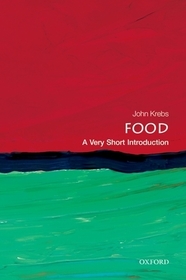
Drawing on a mixture of science and history, Professor Lord John Krebs looks at the development of food and the four great transitions that affected the way we eat. From issues such as the obesity crisis and sustainable agriculture to food scares and the role of new technologies, Krebs provides a fascinating exploration of the history of human food.
MoreLong description:
In this Very Short Introduction, Prof Lord John Krebs provides a brief history of human food, from our remote ancestors 3 million years ago to the present day. By looking at the four great transitions in human food - cooking, agriculture, processing, and preservation - he considers a variety of questions, including why people like some kinds of foods and not others; how your senses contribute to flavour; the role of genetics in our likes and dislikes; and the differences in learning and culture around the world.
In turn he considers aspects of diet, nutrition, and health, and the disparity between malnutrition in some places and overconsumption in others. Finally, he considers some of the big issues - the obesity crisis, sustainable agriculture, the role of new technologies such as genetic modification of crops, and ends by posing the question: how will it be possible to feed a population of 9 billion in 2050, without destroying our natural environment?
ABOUT THE SERIES: The Very Short Introductions series from Oxford University Press contains hundreds of titles in almost every subject area. These pocket-sized books are the perfect way to get ahead in a new subject quickly. Our expert authors combine facts, analysis, perspective, new ideas, and enthusiasm to make interesting and challenging topics highly readable.
excellent book
Table of Contents:
The Gourmet Ape
I like it!
When Food Goes Wrong
You are what you eat
Feeding the 9 billion
Further Reading
References

