

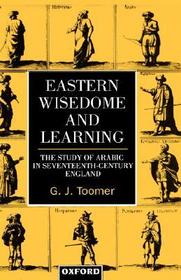
Eastern Wisedome and Learning
The Study of Arabic in Seventeenth-Century England
- Publisher's listprice GBP 297.50
-
134 321 Ft (127 925 Ft + 5% VAT)
The price is estimated because at the time of ordering we do not know what conversion rates will apply to HUF / product currency when the book arrives. In case HUF is weaker, the price increases slightly, in case HUF is stronger, the price goes lower slightly.
- Discount 10% (cc. 13 432 Ft off)
- Discounted price 120 889 Ft (115 133 Ft + 5% VAT)
Subcribe now and take benefit of a favourable price.
Subscribe
134 321 Ft

Availability
printed on demand
Why don't you give exact delivery time?
Delivery time is estimated on our previous experiences. We give estimations only, because we order from outside Hungary, and the delivery time mainly depends on how quickly the publisher supplies the book. Faster or slower deliveries both happen, but we do our best to supply as quickly as possible.
Product details:
- Publisher Clarendon Press
- Date of Publication 28 March 1996
- ISBN 9780198202912
- Binding Hardback
- No. of pages396 pages
- Size 223x145x28 mm
- Weight 652 g
- Language English 0
Categories
Short description:
In the England of 1600 Arabic was merely exotic. Only one Englishman knew it well and almost no Arabic books were available. By 1666 England ranked foremost in Europe in the study of Arabic. There were permanent Chairs for it at Oxford and Cambridge, Arabic printing presses in Oxford and London had produced important works, and a great Arabic library was accumulating at Oxford. In this masterly and original study Professor Toomer explains how this extraordinary change came about, and why there was a drastic decline towards the end of the century.
MoreLong description:
This book narrates the extraordinary growth in the study of Arabic in England from the late sixteenth century, when it was almost non-existent, to the end of the seventeenth. By its high point around 1666, England was pre-eminent among European countries in the study of Arabic. Permanent Chairs of Arabic had been established at Oxford and Cambridge, and specialized presses in Oxford and London had produced Arabic works. The Professor at Oxford, Edward Pococke, was recognized as the foremost scholar in the field in Europe, and a great collection of Arabic manuscripts, begun by Archbishop Laud, was being built up at Oxford.
In this masterly and original study, Professor Toomer gives the first detailed account of this process, set against the religious and political background in England and Europe. He shows how trade with the Ottoman Empire and mistrust of Islam influenced the study of Arabic. Finally, he traces the course and causes of the drastic decline in Arabic studies towards the end of the century.
a treasure-trove that any student of the contacts between Europe and the Islamic workd can now use a s guide in order to elaborate any of the issues not already covered extensively by Toomer ... the analytical expositions of the author are carfully woven together and constitute in themselves a rich groundwork for dissertations in progress and those yet to be written.

