

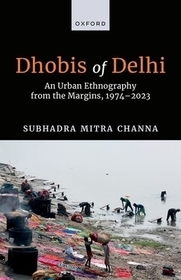
Dhobis of Delhi
An Urban Ethnography from the Margins, 1974–2023
- Publisher's listprice GBP 90.00
-
40 635 Ft (38 700 Ft + 5% VAT)
The price is estimated because at the time of ordering we do not know what conversion rates will apply to HUF / product currency when the book arrives. In case HUF is weaker, the price increases slightly, in case HUF is stronger, the price goes lower slightly.
- Discount 10% (cc. 4 064 Ft off)
- Discounted price 36 572 Ft (34 830 Ft + 5% VAT)
Subcribe now and take benefit of a favourable price.
Subscribe
40 635 Ft

Availability
printed on demand
Why don't you give exact delivery time?
Delivery time is estimated on our previous experiences. We give estimations only, because we order from outside Hungary, and the delivery time mainly depends on how quickly the publisher supplies the book. Faster or slower deliveries both happen, but we do our best to supply as quickly as possible.
Product details:
- Publisher OUP Oxford
- Date of Publication 12 September 2024
- ISBN 9780198926207
- Binding Hardback
- No. of pages272 pages
- Size 216x140 mm
- Weight 10 g
- Language English 537
Categories
Short description:
Dhobis of Delhi covers more than forty years of interactions with an 'untouchable' caste--the Dhobis (washermen and washerwomen), who are among Delhi's oldest inhabitants, describing their ways of life, economy, livelihood, struggles, and adaptation to the city's changing demographic, cultural, and politico-economic profile.
MoreLong description:
Dhobis of Delhi: An Urban Ethnography from the Margins, 1974–2023 is a saga covering more than four decades of interactions with an 'untouchable' caste--the Dhobis (washermen and washerwomen), who are among Delhi's oldest inhabitants. It describes their ways of life, economy, livelihood, struggles, and adaptation to the city's changing demographic, cultural, and politico-economic profile. Utilizing an experiential perspective and a gendered and feminist approach, the author elaborates on the Dhobi identity, which is focused on their community (biradari), and discusses their struggles to be identified as skilled professionals at par with others, rejecting at the same time the political identity of being Dalit. Discarding their earlier subjugated sense of the self, the Dhobis are developing an emerging consciousness as democratic citizens, nurturing ambitions of a future where they will find acceptance as a community. To that end, the book also analyses how their marginalized caste-based occupation and skills ensure for them a livelihood and viability within the market economy. Highlighting the community's strategies and tactics of survival and resilience against all odds, Dhobis of Delhi is thus the story of a city viewed through the eyes of those who live on the lowest rung of its social hierarchy but whose contribution to the life of the city is essential, albeit invisible.
An illuminating contribution to the study of cities and margins worldwide, the anthropology of South Asia, caste, or class, this book is an eye-opening exploration of choices people make to identify themselves with particular social movements, advocacy groups, and political ideologies. The product of many years of ethnographic engagement, this work is both about Delhi and a small community in the city--a group of 'untouchables' who have chosen not to join the Dalit movement or identify as Dalit. How the modern city affects the Dhobi becomes clear in Channa's work, something both engrossing and humanistic. I can think of no one as knowledgeable and insightful as she is in this book.
Table of Contents:
Introduction: Doing Urban Ethnography in the Present
The Dhobis of Old Delhi: Narratives from the Margin about a Community, a River, and a City
The Social World of the Dhobis
Livelihood, Resources, and Strategies for Survival
Living Life as a Dhobi (Man and Woman)
Negotiating Power in the Realm of the Sacred
The Political Realm
Conclusion: Surviving in a Discriminatory World and the Future of the City

