

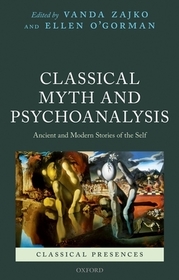
Classical Myth and Psychoanalysis
Ancient and Modern Stories of the Self
Series: Classical Presences;
- Publisher's listprice GBP 105.00
-
47 407 Ft (45 150 Ft + 5% VAT)
The price is estimated because at the time of ordering we do not know what conversion rates will apply to HUF / product currency when the book arrives. In case HUF is weaker, the price increases slightly, in case HUF is stronger, the price goes lower slightly.
- Discount 10% (cc. 4 741 Ft off)
- Discounted price 42 667 Ft (40 635 Ft + 5% VAT)
Subcribe now and take benefit of a favourable price.
Subscribe
47 407 Ft

Availability
printed on demand
Why don't you give exact delivery time?
Delivery time is estimated on our previous experiences. We give estimations only, because we order from outside Hungary, and the delivery time mainly depends on how quickly the publisher supplies the book. Faster or slower deliveries both happen, but we do our best to supply as quickly as possible.
Product details:
- Publisher OUP Oxford
- Date of Publication 27 June 2013
- ISBN 9780199656677
- Binding Hardback
- No. of pages386 pages
- Size 222x148x27 mm
- Weight 600 g
- Language English 0
Categories
Short description:
This volume examines the inter-relationship of classical myth and psychoanalysis from the generation before Freud to the present day, engaging with debates about the role of classical myth in modernity, the importance of psychoanalytic ideas for cultural critique, and its ongoing relevance to ways of conceiving the self.
MoreLong description:
Since Freud published the Interpretation of Dreams in 1900 and utilized Sophocles' Oedipus Rex to work through his developing ideas about the psycho-sexual development of children, it has been virtually impossible to think about psychoanalysis without reference to classical myth. Myth has the capacity to transcend the context of any particular retelling, continuing to transform our understanding of the present. Throughout the twentieth century, experts on the ancient world have turned to the insights of psychoanalytic criticism to supplement and inform their readings of classical myth and literature.
This volume examines the inter-relationship of classical myth and psychoanalysis from the generation before Freud to the present day, engaging with debates about the role of classical myth in modernity, the importance of psychoanalytic ideas for cultural critique, and its ongoing relevance to ways of conceiving the self. The chapters trace the historical roots of terms in everyday usage, such as narcissism and the phallic symbol, in the reception of Classical Greece, and cover a variety of both classical and psychoanalytic texts.
It is a collection that will make an impact on psychoanalytic studies, as well as classics, with re-evaluations of psychoanalytic narcissism and masculinity, and of Freud's engagements with ancient myth, drama and epic.
Table of Contents:
Contents
List of contributors
Note on the referencing of Freud's works
Introduction
Myths and their Receptions: Narrative, Antiquity, and the Unconscious
I. Contexts For Freud
Freud's Empedocles: The Future of a Dualism
Freud's Phallic Symbol
Myth, Religion, Illusion: How Freud Got His Fire Back
Narcissism against Narcissus? A Classical Myth and its Influence on the Elaboration of Early Psychoanalysis from Binet to Jung
Who cares whether Pandora had a large pithos or a small pyxis? Jane Harrison and the emergence of a dynamic conception of the unconscious
II. Freud and Vergil
Freud's Vergil
Juno & the Symptom
Tu Marcellus Eris: Nachträglichkei in Aeneid 6
III. Beyond the Canon
The Mythic Foundation of Law
Obeying Your Father: Stoic Theology between Myth and Masochism
Valerius Maximus and the hysteria of virtue
Mythology and the Abject in Imperial Satire
IV. Myth as Narrative and Icon
Playing with Fire: Prometheus and the Mythological Consciousness
The Ethics of Metamorphosis or A Poet Between Two Deaths
In the beginning was the Deed: On Oedipus and Cain
Aristophanes Myth of Eros and Contemporary Psychologies of the Self
V. Reflexivity and Meta-Narrative
Aristotle on Poets as Parents and the Hellenistic Poet as Mother
Listening, Counter-Transference, and the Classicist as Subject-Supposed-to-Know
Bibliography
Index

