

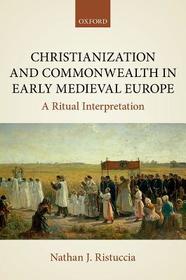
Christianization and Commonwealth in Early Medieval Europe
A Ritual Interpretation
- Publisher's listprice GBP 117.50
-
53 051 Ft (50 525 Ft + 5% VAT)
The price is estimated because at the time of ordering we do not know what conversion rates will apply to HUF / product currency when the book arrives. In case HUF is weaker, the price increases slightly, in case HUF is stronger, the price goes lower slightly.
- Discount 10% (cc. 5 305 Ft off)
- Discounted price 47 746 Ft (45 473 Ft + 5% VAT)
Subcribe now and take benefit of a favourable price.
Subscribe
53 051 Ft

Availability
printed on demand
Why don't you give exact delivery time?
Delivery time is estimated on our previous experiences. We give estimations only, because we order from outside Hungary, and the delivery time mainly depends on how quickly the publisher supplies the book. Faster or slower deliveries both happen, but we do our best to supply as quickly as possible.
Product details:
- Publisher OUP Oxford
- Date of Publication 8 March 2018
- ISBN 9780198810209
- Binding Hardback
- No. of pages274 pages
- Size 241x164x22 mm
- Weight 566 g
- Language English 0
Categories
Short description:
A reassessment of the spread of Christianity in Western Europe. It examines one prominent Christian feast-Rogationtide--in order to argue that the modern religious borders between Christianity, Judaism, and paganism did not exist in the early Middle ages.
MoreLong description:
Christianization and Commonwealth in Early Medieval Europe re-examines the alterations in Western European life that followed widespread conversion to Christianity-the phenomena traditionally termed "Christianization". It refocuses scholarly paradigms for Christianization around the development of mandatory rituals. One prominent ritual, Rogationtide supplies an ideal case study demonstrating a new paradigm of "Christianization without religion." Christianization in the Middle Ages was not a slow process through which a Christian system of religious beliefs and practices replaced an earlier pagan system. In the Middle Ages, religion did not exist in the sense of a fixed system of belief bounded off from other spheres of life. Rather, Christianization was primarily ritual performance. Being a Christian meant joining a local church community.
After the fall of Rome, mandatory rituals such as Rogationtide arose to separate a Christian commonwealth from the pagans, heretics, and Jews outside it. A Latin West between the polis and the parish had its own institution-the Rogation procession-for organizing local communities. For medieval people, sectarian borders were often flexible and rituals served to demarcate these borders. Rogationtide is an ideal case study of this demarcation, because it was an emotionally powerful feast, which combined pageantry with doctrinal instruction, community formation, social ranking, devotional exercises, and bodily mortification. As a result, rival groups quarrelled over the holiday's meaning and procedure, sometimes violently, in order to reshape the local order and ban people and practices as non-Christian.
Christianization and Commonwealth narrates a compelling history, which questions the under-examined concept of Christianization ...
Table of Contents:
List of Abbreviations
Introduction: Tales of Christianizations
The Fall of Rome and the Ascent of Rogationtide
Rome Purified: The Myth of Pagan Survival
Beating the Bounds of the Christian
Disrupting Rites and Profaning the Sacred
Praying Orthodoxy
Conclusion: Ritual and Christianness
Bibliography

