

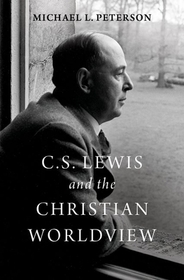
C. S. Lewis and the Christian Worldview
A Philosophical, Theological, and Apologetic Exploration
- Publisher's listprice GBP 30.99
-
13 991 Ft (13 325 Ft + 5% VAT)
The price is estimated because at the time of ordering we do not know what conversion rates will apply to HUF / product currency when the book arrives. In case HUF is weaker, the price increases slightly, in case HUF is stronger, the price goes lower slightly.
- Discount 10% (cc. 1 399 Ft off)
- Discounted price 12 592 Ft (11 993 Ft + 5% VAT)
Subcribe now and take benefit of a favourable price.
Subscribe
13 991 Ft

Availability
printed on demand
Why don't you give exact delivery time?
Delivery time is estimated on our previous experiences. We give estimations only, because we order from outside Hungary, and the delivery time mainly depends on how quickly the publisher supplies the book. Faster or slower deliveries both happen, but we do our best to supply as quickly as possible.
Product details:
- Publisher OUP USA
- Date of Publication 2 April 2020
- ISBN 9780190201111
- Binding Hardback
- No. of pages240 pages
- Size 259x165x27 mm
- Weight 499 g
- Language English 0
Categories
Short description:
C. S. Lewis is one of the most influential and beloved Christian writers of the past century, and interest in him continues to grow as books about his fantasy, fiction, and biography continue to appear. Although Lewis's personal journey was a deeply philosophical search for the most adequate worldview, the few extant books about his Christian philosophy focus on specific topics rather than his overall worldview. In this book, Michael Peterson develops a comprehensive framework for understanding Lewis's Christian worldview--from his arguments from reason, morality, and desire to his ideas about Incarnation, Trinity, and Atonement.
MoreLong description:
C. S. Lewis is one of the most influential and beloved Christian writers of the past century, and interest in him continues to grow as books about his fantasy, fiction, and biography continue to appear. Although Lewis's personal journey was a deeply philosophical search for the most adequate worldview, the few extant books about his Christian philosophy focus on specific topics rather than his overall worldview. In this book, Michael Peterson develops a comprehensive framework for understanding Lewis's Christian worldview--from his arguments from reason, morality, and desire to his ideas about Incarnation, Trinity, and Atonement.
All worldviews address fundamental questions about reality, knowledge, human nature, meaning, and so forth. Peterson therefore examines Lewis's Christian approach to these same questions in interaction with other worldviews. Accenting that the intellectual strength and existential relevance of Lewis's works rest on his philosophical acumen as well as his Christian orthodoxy--which he famously called "mere Christianity"--Peterson skillfully shows how Lewis's Christian thought engages a variety of important problems raised by believers and nonbelievers alike: the problem of evil and suffering, the problem of religious diversity, the problem of meaning, and others. Just as Lewis was gifted in communicating philosophical ideas and arguments in an accessible style, Peterson has crafted a major contribution to Lewis scholarship presented in a way that will interest scholars and benefit the general reader.
a unique and insightful account of the ongoing development of Lewis's processes of thought.
Table of Contents:
Preface
Abbreviations
Introduction
1. Lewis's Intellectual Framework
2. Worldview Engagement
3. Joy and the Meaning of Life
4. Mind, Miracle, and Nature
5. Moral Law and the Structure of Personal Reality
6. Humanity and the Incarnation
7. The Social God and the Relational Creation
8. Pain, Suffering, and Death
9. Science, Scientism, and Evolution
10. Salvation and Persons Outside the Faith
11. Prayer and Providence
12. Heaven, Hell, and the Trajectory of Finite Personality
Appendix A: Timeline of Lewis's Journey
Appendix B: The Lewis - Van Osdall Correspondence
Glossary
References
Notes
Index

