

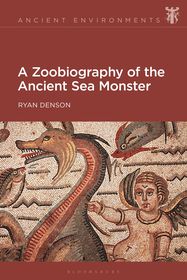
A Zoobiography of the Ancient Sea Monster
Series: Ancient Environments;
- Publisher's listprice GBP 85.00
-
38 377 Ft (36 550 Ft + 5% VAT)
The price is estimated because at the time of ordering we do not know what conversion rates will apply to HUF / product currency when the book arrives. In case HUF is weaker, the price increases slightly, in case HUF is stronger, the price goes lower slightly.
- Discount 10% (cc. 3 837 Ft off)
- Discounted price 34 540 Ft (32 895 Ft + 5% VAT)
Subcribe now and take benefit of a favourable price.
Subscribe
38 377 Ft

Availability
Not yet published.
Why don't you give exact delivery time?
Delivery time is estimated on our previous experiences. We give estimations only, because we order from outside Hungary, and the delivery time mainly depends on how quickly the publisher supplies the book. Faster or slower deliveries both happen, but we do our best to supply as quickly as possible.
Product details:
- Publisher Bloomsbury Publishing (UK)
- Date of Publication 3 September 2026
- Number of Volumes Hardback
- ISBN 9781350451872
- Binding Hardback
- No. of pages232 pages
- Size 234x156 mm
- Language English
- Illustrations 17 bw illus 700
Categories
Long description:
Examining a vast corpus of literary references and artistic representations, this volume offers the first comprehensive study of the ketos - the sea monster imagined by the ancient Greeks and Romans.
The chapters examine the three central traditions of thought that existed about this imaginary animal in Graeco-Roman culture. The first tradition concerns the ketos as a divinely associated monster: a force aligned with marine gods (chiefly Poseidon) and one which was fought by Heracles and Perseus. The second tradition features the ketos in more naturalised contexts, as depicted among ancient geographers and historians, as a type of monster roaming the distant waters of the Atlantic and Indian Oceans. The third tradition concerns the fusion of the ketos with Leviathan and the other Old Testament sea monsters in the minds of early Christians. Accordingly, this classical sea monster became the image of the creature that swallowed Jonah, and, alternatively, a monster associated with the Devil and cosmological evil.
While other monsters of Graeco-Roman mythology, such as the Minotaur and Medusa, are household names in modern popular culture, the ketos has effectively been lost in the modern imagination. Yet it was no small part of the Graeco-Roman imagination. This sea monster formed a key aspect as to how the sea-adjacent societies of ancient Greece and Rome perceived ancient marine environments. It was this fantastic sea beast that so haunted ancient mariners, and in turn, which contributed to ancient perceptions of the marine world as a profoundly alien and hostile environment.
Table of Contents:
List of Figures
List of Tables
Acknowledgements
Series Preface
Note on Orthography
List of Abbreviations
Introduction: Recovering a Lost Classical Monster
Part One: The Divinely Associated Tradition
Chapter 1: The Pets of Marine Divinities
Chapter 2: The Hesione and Andromeda Myths
Part Two: The Ethnographical Tradition
Chapter 3: The Kete of the Mediterranean
Chapter 4: The Kete of the Outer Seas
Part Three: The Christian Tradition
Chapter 5: Jonah's Ketos
Chapter 6: The Christian Assimilation of Leviathan and the Ketos
Conclusion: Did the Ancient Greeks and Romans Believe in their Sea Monsters?
Notes
Bibliography
Index
Notes
Bibliography
Index

