

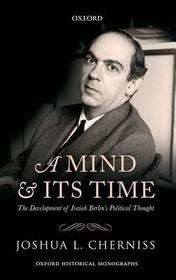
A Mind and its Time
The Development of Isaiah Berlin's Political Thought
Series: Oxford Historical Monographs;
- Publisher's listprice GBP 137.50
-
62 081 Ft (59 125 Ft + 5% VAT)
The price is estimated because at the time of ordering we do not know what conversion rates will apply to HUF / product currency when the book arrives. In case HUF is weaker, the price increases slightly, in case HUF is stronger, the price goes lower slightly.
- Discount 10% (cc. 6 208 Ft off)
- Discounted price 55 873 Ft (53 213 Ft + 5% VAT)
Subcribe now and take benefit of a favourable price.
Subscribe
62 081 Ft

Availability
printed on demand
Why don't you give exact delivery time?
Delivery time is estimated on our previous experiences. We give estimations only, because we order from outside Hungary, and the delivery time mainly depends on how quickly the publisher supplies the book. Faster or slower deliveries both happen, but we do our best to supply as quickly as possible.
Product details:
- Publisher OUP Oxford
- Date of Publication 28 March 2013
- ISBN 9780199673261
- Binding Hardback
- No. of pages284 pages
- Size 223x148x21 mm
- Weight 480 g
- Language English 0
Categories
Short description:
A detailed study of Isaiah Berlin: historian, philosopher, and political theorist. Situates his evolving ideas in the context of British society and world politics. Offers a new interpretation of Berlin's influential writings on liberty and his debts to philosophy, and makes clear his relationship to the political debates of his times.
MoreLong description:
A Mind and its Time offers the most detailed account to date of the genesis and development of Isaiah Berlin's political thought, philosophical views, and historical understanding. Drawing on both little-known published material and archival sources, it locates Berlin's evolving intellectual interests and political positions in the context of the events and trends of interwar and post-war intellectual and political life. Special emphasis is placed on the roots of Berlin's later pluralism in philosophical and cultural debates of the interwar period, his concern with the relationship between ethics and political conduct, and his evolving account of liberty. Berlin's distinctive liberalism is shown to have been shaped by his response to the cultural politics of interwar period, and the political and ethical dilemmas of the early Cold War era; and to what Berlin saw as a dangerous embrace of an elitist, technocratic, scientistic and "managerial" intellectual and political stance by liberals themselves. At the same time, Berlin's attitude toward what he called "positive liberty" emerges as far more complicated and ambivalent than is often realized. Joshua L. Cherniss reveals the multiplicity of Berlin's influences and interlocutors, the shifts in his thinking, and the striking consistency of his concerns and commitments. In shedding new light on Berlin's thought, and offering a better understanding of his place in the development of liberal thought in the twentieth century, he makes fresh contributions both to understanding the intellectual history of the twentieth century, and to discussions of liberty and liberalism in political theory.
meticulously researched ... Cherniss does an excellant job working through the intricacies of Berlin's thought without oversimplifying it
Table of Contents:
Preface
Acknowledgements
'Not a very political thinker'?
War and Peace
Anti-Communist Manifestoes
Against 'Engineers of Human Souls'
Between Realism and Utopianism
The Road to Liberty
Conceiving Liberty
The Inner Citadel
Conclusion
Bibliography
Index

