

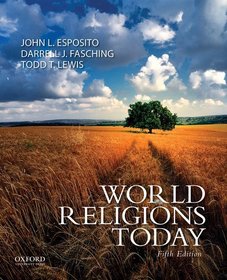
World Religions Today
-
10% KEDVEZMÉNY?
- A kedvezmény csak az 'Értesítés a kedvenc témákról' hírlevelünk címzettjeinek rendeléseire érvényes.
- Kiadói listaár GBP 59.00
-
26 638 Ft (25 370 Ft + 5% áfa)
Az ár azért becsült, mert a rendelés pillanatában nem lehet pontosan tudni, hogy a beérkezéskor milyen lesz a forint árfolyama az adott termék eredeti devizájához képest. Ha a forint romlana, kissé többet, ha javulna, kissé kevesebbet kell majd fizetnie.
- Kedvezmény(ek) 10% (kb. 2 663 Ft)
- Kedvezményes ár 23 975 Ft (22 833 Ft + 5% áfa)
Iratkozzon fel most és részesüljön kedvezőbb árainkból!
Feliratkozom
26 638 Ft

Beszerezhetőség
A kiadónál véglegesen elfogyott, nem rendelhető. Érdemes újra keresni a címmel, hátha van újabb kiadás.
Why don't you give exact delivery time?
A beszerzés időigényét az eddigi tapasztalatokra alapozva adjuk meg. Azért becsült, mert a terméket külföldről hozzuk be, így a kiadó kiszolgálásának pillanatnyi gyorsaságától is függ. A megadottnál gyorsabb és lassabb szállítás is elképzelhető, de mindent megteszünk, hogy Ön a lehető leghamarabb jusson hozzá a termékhez.
A termék adatai:
- Kiadás sorszáma 5
- Kiadó OUP USA
- Megjelenés dátuma 2014. december 18.
- ISBN 9780199999590
- Kötéstípus Puhakötés
- Terjedelem688 oldal
- Méret 236x194x23 mm
- Súly 1072 g
- Nyelv angol
- Illusztrációk 282 illustrations 0
Kategóriák
Hosszú leírás:
Revealing the significance of religion in contemporary life, World Religions Today, Fifth Edition, explores major religious traditions—Judaism, Christianity, Islam, Hinduism, Buddhism, South Asian religions, East Asian religions, indigenous religions, and new religions—as dynamic, ongoing forces in the lives of individuals and in the collective experience of modern societies. This unique volume accomplishes two goals: it connects today's religions
to their classical beliefs and practices and focuses on how these religions have both radically changed the modern world and been changed by it. The book is enhanced by numerous pedagogical aids—text boxes, timelines, maps, illustrations, discussion questions, a comprehensive glossary of key terms, and suggestions
for further reading—and more than 200 photographs. For a wealth of additional teaching and study resources, visit www.oup.com/us/esposito.
World Religions Today, Fifth Edition, is also available as two separate volumes:
Religions of Asia Today, Third Edition: 978-0-19-999964-4
Religions of the West Today, Third Edition: 978-0-19-999963-7
World Religions Today does an excellent job of helping students to place religion in the contemporary world.
Tartalomjegyzék:
Chapters 2-9 open with an Overview. All chapters end with a Conclusion.
CHAPTER 1. INTRODUCTION
Globalization: World Religions in Everyone's Hometown
Why Study World Religions?
Our Task
Understanding Religious Experience and Its Formative Elements
The Sacred
Myth, Scripture, and Beliefs
Ritual
Community and Morality
Religious Leaders/Experts
The Great Religious Stories of the World
The Myths of Nature
China and the Myths of Harmony
India and the Myths of Liberation
The Middle East and the Myths of History
Religious Diversity and Historical Change: The Structure of this Book
Historical Overview: From Premodern to Postmodern
The Modern/Postmodern Transition: Colonialism, the Socialist Challenge, and the End of Modernity
Postmodern Trends in a Postcolonial World
Conclusion: We Are All Heretics in the Postmodern Situation
CHAPTER 2. INDIGENOUS RELIGIONS
Origins of Homo religiosus: Prehistory
Religion's Origins Among Hunter-Gatherers
Fertility, Childbirth, and Survival
Religion in Prehistory: The Secret of Early Cave Rituals
Indigenous Religious Traditions: Soul Belief and Afterlife
Totemism: Australian Aboriginal Religion
Shamans: "Technicians of the Sacred"
Bear Sacrifice: A Widespread Arctic and Pacific Rim Tradition
Shamans Who "Repair the World"
Indigenous Religions Today
The Cataclysms of Colonialism
Shamanism in Modern Asia: Division of Labor Within the World Religions
Global Neo-Shamanism: Expropriation by "White Shamans"
CHAPTER 3. THE MANY STORIES OF JUDAISM: SACRED AND SECULAR
Encounter with Modernity: Modern Judaisms and the Challenge of Ultra-Orthodoxy
The Conflict over Public Life: Religion and Politics in the State of Israel
Premodern Judaism: The Formative Era (2000 BCE-500 CE)
The Biblical Roots of Judaism
The Historical Roots of Diversity
Exodus and Exile: Story, History, and Modernity
From Torah to Talmud
Premodern Judaism: The Classical Era (500 CE-1729 CE)
The Premodern Rabbinic World: God, Torah, and Israel
The Medieval Journey of Judaism
Two Great Medieval Scholars: Rashi and Maimonides
Kabbalah—Jewish Mysticism
Hasidism
Judaism and Modernity (1729-1967)
The Emergence of Modern Religious Forms of Judaism
The Emergence of Secular Forms of Judaism
Judaism and Postmodern Trends in a Postcolonial World (1967- )
Challenges to Jewish Faith After the Holocaust
Challenges to Jewish Existence After the Holocaust
CHAPTER 4. CHRISTIAN DIVERSITY AND THE ROAD TO MODERNITY
Encounter with Modernity: The Fundamentalist-Modernist Controversy (1859-)
The Protestant Confrontation with Modernity
The Catholic Confrontation with Modernity
The Nineteenth-Century Historical and Social-Scientific Revolution
Premodern Christianity: The Formative Era (31-451 CE)
The New Testament and the Life of Jesus
Apocalypse: The Book of Revelation
Christianity's Emergence from Judaism
The Fall of the Temple
The Origins of Christian Anti-Jewish Sentiment
Jesus as Son of God
Constantinianism: The Marriage of Christianity and Empire
Augustine, Architect of Western Christianity
Premodern Christianity: The Classical Era (451-1517 CE)
The Medieval Worldview: Sacraments and Festivals
The Two Cities Revisited
The Promise and Threat of Christian Mysticism
Christianity, Judaism, Islam: Crusades and Inquisition
Christianity and Modernity (1517-1962)
The Emergence of Modernity
Millennialism: History as Progress
The Via Moderna and Devotio Moderna
Devotio Moderna and the Protestant Reformation
Calvin and the Protestant Ethic
Other Reform Movements
Religious Diversity: Church and State in War and Peace
Enlightenment Rationalism and Christian Pietism
Nineteenth-Century Romanticism and Existentialism
From the Holocaust to Hiroshima: The Global Collapse of the Modern Myth of History as Progress
Christianity and Postmodern Trends in a Postcolonial World (1962-)
From Colonial to Postcolonial Christianity
Latin America
Africa
Asia
North America—The United States
Conclusion: The Challenge of Religious Pluralism
CHAPTER 5. ISLAM: THE MANY FACES OF THE MUSLIM EXPERIENCE
Encounter with Modernity: The Challenge of Western Colonialism
The Islamic Resurgence
Islam in the West
Premodern Islam: The Formative Era
Muhammad's Early Life
After the Hijra
The Message of the Quran
A Golden Age of Expansion, Conquest, and Creativity
Diversity, Diversion, and Dissent
The Origins of the Sunni and Shiah Split
Premodern Islam: The Classical Era
Law and Mysticism: The Outer and Inner Paths to God
The Five Pillars of Islam
Women and Muslim Family Law
The Interior Path of Love: Islamic Mysticism
Islam and the State
Islam and the West (Christendom): The Crusades
Premodern Revivalist Movements
Islam and Modernity
Islamic Modernism
Modern Revivalist (Fundamentalist) Movements
Radical Islam
Islam and Postmodern Trends in a Postcolonial World
The Impact of the Islamic Resurgence
Islam in Modern State and Society
The Failure of Modernity and the Islamic Revival
The Religious Worldview of Contemporary Islamic Activism
From the Periphery to Mainstream Politics and Society
The Road to 9/11
Globalization and Hijacking of Jihad
Jihad as Armed Struggle
Suicide Bombing: War of the Fatwas
Post 9/11: Impact and Response
Islam and the Arab Awakening: Between Authoritarianism and Pluralism
Questions for Postmodern Times: Issues of Authority and Interpretation
Islam in the West
The Transformation of the "Nation of Islam"
Islam: Postmodern Challenges
Islamization of the Law
Women and Minorities
Islamic Reform
CHAPTER 6. HINDUISM, JAINISM, AND SIKHISM: SOUTH ASIAN RELIGIONS
Defining Hinduism: Unity, Diversity, Localities
Encounter with Modernity: Hindu Challenges to India as a Secular State
Premodern Hinduism: The Formative Era
The Aryans and Religion in the Vedic Era
Vedic Religion
Karma, Yoga, and the Quest for Liberation
Yoga
Premodern Hinduism: The Classical Era (180 BCE-900 CE)
"Early Heterodox" Indic Religions: Jainism and Buddhism
Jainism: The Tradition of Spiritual Conquerors
The Reality of Karma and Caste
The Four Stages of Life
The Four Aims of Life
Epics and the Development of Classical Hinduism
Mainstream Hinduism and the Rise of Devotion to the Great Deities
Premodern Hinduism: The Postclassical Era (900 CE-1500 CE)
The Formation of Major Hindu Schools of Thought
The Early Islamic Era: Delhi Sultanate (1192-1525)
Religion in the Mughal Era (1526-1707)
Hinduism and Modernity
Hinduism Under British Colonialism
Challenges and Responses to Colonialism
The Work of Gandhi: Hindu Elements in Indian Nationalism
Hinduism and Postmodern Trends in a Postcolonial World
The Persistence of Traditional Religious Understandings
Contemporary Hindu Practices
Hindu and Sikh Festival Practice
Pilgrimage Festivals
Sikh Festivals
The Religious Institutions of Contemporary Hinduism
Changes and Continuities: Examples of Postcolonial Hinduism
The Connection of Religion with Philanthropy and Social Reform
Religious Nationalism: Secular India and its Discontents
A Growing Global Tradition
CHAPTER 7. BUDDHISM: PATHS TOWARD NIRVANA
Encounter with Modernity: Socially "Engaged Buddhism"
Premodern Buddhism: The Formative Era (600 BCE-100 CE)
The Buddha: Context and Biography
Buddhism as the Path to Nirvana
The First Community and Its Development
How Buddhism Became a World Religion
Sangha and Monastery: The Institutional Vehicles of Buddhism's Expansion
Premodern Buddhism: The Classical Era (100-800 CE)
The Pan-Asian Expansion of Buddhism
The Core Doctrines
The Classical Ideal: Buddhist Civilization
The Mahayana: Philosophies and East Asian Monastic Schools
Premodern Buddhism: Buddhist Expansion (400-1500 CE)
South Asia
China
Southeast Asia
Japan
The Himalayan Region
Buddhism and Modernity
Early Modern Buddhist Polities: Monastics, Householders, Kings
Buddhist Monasticism
Buddhism Under Colonialism (1500-1960)
Challenges from Colonialism, Communism, and Modern Critics (1800-Present)
The Buddhist Twentieth-Century Revival Gains Strength
Buddhism for Western Consumption: Meditation and Atheism
Effects of Japanese Imperialism on Buddhism and on Asia
Buddhism and Postmodern Trends in a Postcolonial World
South Asia
Theravada Buddhism Today in Southeast Asia
Tooth Relics and Anti-Muslim Riots in Myanmar
Three Contemporary Faces of Thai Buddhism
East Asia
Buddhism Today in Diaspora and in Asia
Buddhism's Elective Affinity for Modernization
The Sangha: Adaptive Reformism?
State Buddhism and the Poison of Ethnic Passion
CHAPTER 8. EAST ASIAN RELIGIONS: CONFUCIANISM, DAOISM, SHINTO, BUDDHISM
Geographical Orientation
Countries: China, Koreas, Japan
Connections: Chinese Core and Periphery
Encounter with Modernity: The Fall and Return of Confucianism
The Postcolonial Challenge of Confucianism
East Asian Religions in the Formative Era (1500 BCE-200 CE)
Earliest History: Shang (1766-1122 BCE)
Development of the Multiple Traditions in Post-Han China, Korea, and Japan
Religion Under the Early Japanese Imperial State: Buddhism and Shinto
Classical Imperial China (645-1271 CE)
The Development of Buddhism, Daoism, and Confucianism in Korea and Japan
East Asian Religions in the Late Classical Era (1400-1800)
East Asian Religions in the Early Modern Era
Disruptive European Intrusions
Traumatic Transitions of the Modern Era
The Appearance of New Religious Movements and Religions
East Asian Religions and Postmodern Trends in a Postcolonial World
Continuities and Transformations in the East Asian Religions
The Religious Institutions: Monasteries, Temples, Shrines
The Return of Religion to China: Case Studies
Japan's Creative Diversity: Old Traditions and New
Korea's Strong Confucian Tradition Accommodates Diversity
CHAPTER 9. GLOBALIZATION: FROM NEW TO NEW AGE RELIGIONS
Encounter with Modernity: The Challenge of Global Diversity to the "Purity" of Tradition
New Religions
Old Religions and New Religions in the History of Religions
The New Age and New Age Religions
Postmodernism and the New Age
The New Age—Modern or Postmodern?
The Age of Apocalypse or the Age of Aquarius?
Wicca and the Resurgence of Goddess Worship
J. Z. Knight and the Ramtha School of Enlightenment
Theosophy, Christian Science, and the Unity School of Christianity
Scientology
The Baha'i Global Religious Vision
East Goes West: Zen in America
West Goes East: The Aum Shinrikyo Movement
Conclusion: The Postmodern Challenge-Can There Be a Global Ethic in a World of Religious Diversity?
Beyond Atheism: The Challenge of Postmodern Secular Relativism
"Passing Over": A Postmodern Spiritual Adventure That Responds to the Challenge of Globalization
Tolstoy, Jesus, and "Saint Buddha": An Ancient Tale with a Thousand Faces
The Children of Gandhi: An Experiment in Postmodern Global Ethics
The Future of Religion in an Age of Globalization

