

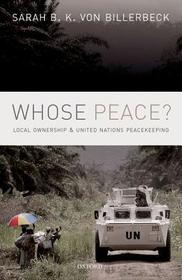
Whose Peace?
Local Ownership and United Nations Peacekeeping
-
10% KEDVEZMÉNY?
- A kedvezmény csak az 'Értesítés a kedvenc témákról' hírlevelünk címzettjeinek rendeléseire érvényes.
- Kiadói listaár GBP 105.00
-
47 407 Ft (45 150 Ft + 5% áfa)
Az ár azért becsült, mert a rendelés pillanatában nem lehet pontosan tudni, hogy a beérkezéskor milyen lesz a forint árfolyama az adott termék eredeti devizájához képest. Ha a forint romlana, kissé többet, ha javulna, kissé kevesebbet kell majd fizetnie.
- Kedvezmény(ek) 10% (kb. 4 740 Ft)
- Kedvezményes ár 42 667 Ft (40 635 Ft + 5% áfa)
Iratkozzon fel most és részesüljön kedvezőbb árainkból!
Feliratkozom
47 407 Ft

Beszerezhetőség
Megrendelésre a kiadó utánnyomja a könyvet. Rendelhető, de a szokásosnál kicsit lassabban érkezik meg.
Why don't you give exact delivery time?
A beszerzés időigényét az eddigi tapasztalatokra alapozva adjuk meg. Azért becsült, mert a terméket külföldről hozzuk be, így a kiadó kiszolgálásának pillanatnyi gyorsaságától is függ. A megadottnál gyorsabb és lassabb szállítás is elképzelhető, de mindent megteszünk, hogy Ön a lehető leghamarabb jusson hozzá a termékhez.
A termék adatai:
- Kiadó OUP Oxford
- Megjelenés dátuma 2016. december 15.
- ISBN 9780198755708
- Kötéstípus Keménykötés
- Terjedelem220 oldal
- Méret 240x169x18 mm
- Súly 470 g
- Nyelv angol 0
Kategóriák
Rövid leírás:
This book examines local ownership in UN peacekeeping and how national and international actors interact and share responsibility in fragile post-conflict contexts.
TöbbHosszú leírás:
Recent years have seen an increasing emphasis on local ownership in United Nations peacekeeping. Advocates assert that it boosts the legitimacy and sustainability of peacekeeping by helping to preserve the principles of self-determination and non-imposition in an activity that can contravene them. However, whether this assertion holds in practice has not been backed up by careful conceptual and empirical analysis.
This book fills this gap by mapping the discourse, understandings, and operationalization of local ownership in UN peacekeeping, both from the perspective of the UN and local actors. Drawing on the case of the UN peacekeeping operation in DR Congo and a number of other cases, it shows that despite its regular invocation of local ownership discourse, the UN operationalizes ownership in restrictive ways that are intended to protect the achievement of operational goals but which consequently limit self-determination and increase external imposition on the host country. This gap between the rhetoric and reality of ownership suggests that the UN uses local ownership primarily as a discursive tool for legitimation, one intended to reconcile conflicting normative and operational imperatives that it faces. However, because its actions do not match its rhetoric, the UN's attempts to generate legitimacy through discourse appear to fall flat, particularly in the eyes of local actors, and because of contradictions in the ways that the UN operationalizes local ownership, it also inhibits the achievement of its operational goals as well.
...von Billerbeck...expand[s] our knowledge of peacekeeping and peacebuilding praxis
Tartalomjegyzék:
Introduction
Conflicting Normative and Operational Imperatives: A Conceptual Framework
The Evolution and Discourse of Local Ownership
Understandings of Local Ownership
Operationalizations of Local Ownership: Practices
Operationalizations of Local Ownership: Actors
Local Ownership: A Discursive Tool?
Local Ownership: An Operational Obstacle?
Conclusion
Annex I: List of Interviewees
Annex II: List of UN Peacekeeping Operations, 1948-2016

