

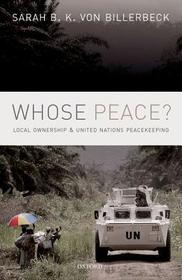
Whose Peace?
Local Ownership and United Nations Peacekeeping
- Publisher's listprice GBP 105.00
-
47 407 Ft (45 150 Ft + 5% VAT)
The price is estimated because at the time of ordering we do not know what conversion rates will apply to HUF / product currency when the book arrives. In case HUF is weaker, the price increases slightly, in case HUF is stronger, the price goes lower slightly.
- Discount 10% (cc. 4 740 Ft off)
- Discounted price 42 667 Ft (40 635 Ft + 5% VAT)
Subcribe now and take benefit of a favourable price.
Subscribe
47 407 Ft

Availability
printed on demand
Why don't you give exact delivery time?
Delivery time is estimated on our previous experiences. We give estimations only, because we order from outside Hungary, and the delivery time mainly depends on how quickly the publisher supplies the book. Faster or slower deliveries both happen, but we do our best to supply as quickly as possible.
Product details:
- Publisher OUP Oxford
- Date of Publication 15 December 2016
- ISBN 9780198755708
- Binding Hardback
- No. of pages220 pages
- Size 240x169x18 mm
- Weight 470 g
- Language English 0
Categories
Short description:
This book examines local ownership in UN peacekeeping and how national and international actors interact and share responsibility in fragile post-conflict contexts.
MoreLong description:
Recent years have seen an increasing emphasis on local ownership in United Nations peacekeeping. Advocates assert that it boosts the legitimacy and sustainability of peacekeeping by helping to preserve the principles of self-determination and non-imposition in an activity that can contravene them. However, whether this assertion holds in practice has not been backed up by careful conceptual and empirical analysis.
This book fills this gap by mapping the discourse, understandings, and operationalization of local ownership in UN peacekeeping, both from the perspective of the UN and local actors. Drawing on the case of the UN peacekeeping operation in DR Congo and a number of other cases, it shows that despite its regular invocation of local ownership discourse, the UN operationalizes ownership in restrictive ways that are intended to protect the achievement of operational goals but which consequently limit self-determination and increase external imposition on the host country. This gap between the rhetoric and reality of ownership suggests that the UN uses local ownership primarily as a discursive tool for legitimation, one intended to reconcile conflicting normative and operational imperatives that it faces. However, because its actions do not match its rhetoric, the UN's attempts to generate legitimacy through discourse appear to fall flat, particularly in the eyes of local actors, and because of contradictions in the ways that the UN operationalizes local ownership, it also inhibits the achievement of its operational goals as well.
...von Billerbeck...expand[s] our knowledge of peacekeeping and peacebuilding praxis
Table of Contents:
Introduction
Conflicting Normative and Operational Imperatives: A Conceptual Framework
The Evolution and Discourse of Local Ownership
Understandings of Local Ownership
Operationalizations of Local Ownership: Practices
Operationalizations of Local Ownership: Actors
Local Ownership: A Discursive Tool?
Local Ownership: An Operational Obstacle?
Conclusion
Annex I: List of Interviewees
Annex II: List of UN Peacekeeping Operations, 1948-2016

