

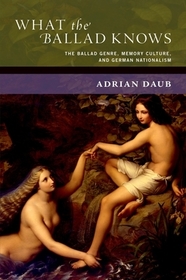
What the Ballad Knows
The Ballad Genre, Memory Culture, and German Nationalism
Sorozatcím: New Cultural History of Music;
-
10% KEDVEZMÉNY?
- A kedvezmény csak az 'Értesítés a kedvenc témákról' hírlevelünk címzettjeinek rendeléseire érvényes.
- Kiadói listaár GBP 74.00
-
35 353 Ft (33 670 Ft + 5% áfa)
Az ár azért becsült, mert a rendelés pillanatában nem lehet pontosan tudni, hogy a beérkezéskor milyen lesz a forint árfolyama az adott termék eredeti devizájához képest. Ha a forint romlana, kissé többet, ha javulna, kissé kevesebbet kell majd fizetnie.
- Kedvezmény(ek) 10% (cc. 3 535 Ft off)
- Kedvezményes ár 31 818 Ft (30 303 Ft + 5% áfa)
Iratkozzon fel most és részesüljön kedvezőbb árainkból!
Feliratkozom
35 353 Ft

Beszerezhetőség
Becsült beszerzési idő: A Prosperónál jelenleg nincsen raktáron, de a kiadónál igen. Beszerzés kb. 3-5 hét..
A Prosperónál jelenleg nincsen raktáron.
Why don't you give exact delivery time?
A beszerzés időigényét az eddigi tapasztalatokra alapozva adjuk meg. Azért becsült, mert a terméket külföldről hozzuk be, így a kiadó kiszolgálásának pillanatnyi gyorsaságától is függ. A megadottnál gyorsabb és lassabb szállítás is elképzelhető, de mindent megteszünk, hogy Ön a lehető leghamarabb jusson hozzá a termékhez.
A termék adatai:
- Kiadó OUP USA
- Megjelenés dátuma 2022. november 14.
- ISBN 9780190885496
- Kötéstípus Keménykötés
- Terjedelem296 oldal
- Méret 163x237x23 mm
- Súly 576 g
- Nyelv angol
- Illusztrációk 15 halftones 262
Kategóriák
Rövid leírás:
In What the Ballad Knows, author Adrian Daub elucidates the complex relationship between ballads and nationalism in 19th century German culture.
TöbbHosszú leírás:
Over the course of the 19th century, ballads proliferated in German-speaking Europe in a truly remarkable range of contexts. Audiences were of course likely encounter balladry in the volumes of Goethe and Schiller, in various anthologies or illustrated editions. But they were just as likely to come across objects billed as ballads in recitation evenings by popular actors, in song-settings by Schubert and Loewe, in piano pieces by Chopin, in the opera house and the concert hall, in mass-produced drawings, paintings and even chinaware. Ballads were poems one could use - schoolteachers used them to train their students' memory (or punish them), women composers used them to assert their place in the musical canon, actors used them to bolster their income, mothers used them to put their children to sleep. Ballads intersected with gender and class, promising to democratize art, while in fact helping make distinctions. In What the Ballad Knows: The Ballad Genre, Memory Culture and German Nationalism, Adrian Daub tells the story of this itinerant genre across media, periods, regions and social strata and shows that, even though it was often positioned as an authentic product of "German spirit," the ballad frequently unsettled and subverted the national project. The popular imagination rooted these poems in pre-modern oral culture, among bards and peasants in the everyday life of common folk. But in fact nineteenth-century ballads were in the end all about modernity – modern modes of association, of attention, of dissemination.
Adrian Daub's brilliant synthesis of the many lives of ballads in German culture breathes new and more complex meaning into Eric Hobsbawm's and Terence Ranger's concept of invented traditions. Daub calls the ballad "poetry one lived with," and his subtle, lucid analysis of its many contexts—travel, family, the schoolroom, the public sphere, the national imaginary—sketches a great arc of continuity in German life. It is erudite, graceful, and wise—a major achievement.
Tartalomjegyzék:
Introduction: What the Ballad Knows
Chapter 1: The Ballad's Years of Travel: The Musenalmanach for 1798, Orality, and the Ballad Form
Chapter 2: The Ballad, The Voice and the Echoes of War
Chapter 3: Balladic Consciousness: The Ballad on the Opera Stage
Chapter 4: Memorizing Ballads: Pedagogy, Tradition and the Open Secret
Chapter 5: The Ballad and the Family
Chapter 6: The Ballad and Its Narratives
Chapter 7: The Ballad, the Public and Gendered Community
Chapter 8: The Ballad and the Sea: Regionalism, Mourning and the Modern National Imaginary
Epilogue: The Ballad as Record
Acknowledgments
Index

