

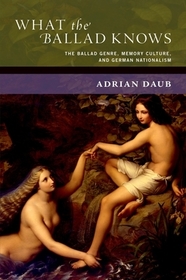
What the Ballad Knows
The Ballad Genre, Memory Culture, and German Nationalism
Series: New Cultural History of Music;
- Publisher's listprice GBP 74.00
-
35 353 Ft (33 670 Ft + 5% VAT)
The price is estimated because at the time of ordering we do not know what conversion rates will apply to HUF / product currency when the book arrives. In case HUF is weaker, the price increases slightly, in case HUF is stronger, the price goes lower slightly.
- Discount 10% (cc. 3 535 Ft off)
- Discounted price 31 818 Ft (30 303 Ft + 5% VAT)
Subcribe now and take benefit of a favourable price.
Subscribe
35 353 Ft

Availability
Estimated delivery time: In stock at the publisher, but not at Prospero's office. Delivery time approx. 3-5 weeks.
Not in stock at Prospero.
Why don't you give exact delivery time?
Delivery time is estimated on our previous experiences. We give estimations only, because we order from outside Hungary, and the delivery time mainly depends on how quickly the publisher supplies the book. Faster or slower deliveries both happen, but we do our best to supply as quickly as possible.
Product details:
- Publisher OUP USA
- Date of Publication 14 November 2022
- ISBN 9780190885496
- Binding Hardback
- No. of pages296 pages
- Size 163x237x23 mm
- Weight 576 g
- Language English
- Illustrations 15 halftones 262
Categories
Short description:
In What the Ballad Knows, author Adrian Daub elucidates the complex relationship between ballads and nationalism in 19th century German culture.
MoreLong description:
Over the course of the 19th century, ballads proliferated in German-speaking Europe in a truly remarkable range of contexts. Audiences were of course likely encounter balladry in the volumes of Goethe and Schiller, in various anthologies or illustrated editions. But they were just as likely to come across objects billed as ballads in recitation evenings by popular actors, in song-settings by Schubert and Loewe, in piano pieces by Chopin, in the opera house and the concert hall, in mass-produced drawings, paintings and even chinaware. Ballads were poems one could use - schoolteachers used them to train their students' memory (or punish them), women composers used them to assert their place in the musical canon, actors used them to bolster their income, mothers used them to put their children to sleep. Ballads intersected with gender and class, promising to democratize art, while in fact helping make distinctions. In What the Ballad Knows: The Ballad Genre, Memory Culture and German Nationalism, Adrian Daub tells the story of this itinerant genre across media, periods, regions and social strata and shows that, even though it was often positioned as an authentic product of "German spirit," the ballad frequently unsettled and subverted the national project. The popular imagination rooted these poems in pre-modern oral culture, among bards and peasants in the everyday life of common folk. But in fact nineteenth-century ballads were in the end all about modernity – modern modes of association, of attention, of dissemination.
Adrian Daub's brilliant synthesis of the many lives of ballads in German culture breathes new and more complex meaning into Eric Hobsbawm's and Terence Ranger's concept of invented traditions. Daub calls the ballad "poetry one lived with," and his subtle, lucid analysis of its many contexts—travel, family, the schoolroom, the public sphere, the national imaginary—sketches a great arc of continuity in German life. It is erudite, graceful, and wise—a major achievement.
Table of Contents:
Introduction: What the Ballad Knows
Chapter 1: The Ballad's Years of Travel: The Musenalmanach for 1798, Orality, and the Ballad Form
Chapter 2: The Ballad, The Voice and the Echoes of War
Chapter 3: Balladic Consciousness: The Ballad on the Opera Stage
Chapter 4: Memorizing Ballads: Pedagogy, Tradition and the Open Secret
Chapter 5: The Ballad and the Family
Chapter 6: The Ballad and Its Narratives
Chapter 7: The Ballad, the Public and Gendered Community
Chapter 8: The Ballad and the Sea: Regionalism, Mourning and the Modern National Imaginary
Epilogue: The Ballad as Record
Acknowledgments
Index

