

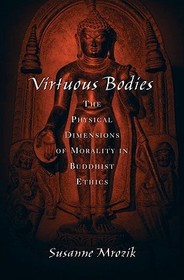
Virtuous Bodies
The Physical Dimensions of Morality in Buddhist Ethics
Sorozatcím: AAR Cultural Criticism Series;
-
10% KEDVEZMÉNY?
- A kedvezmény csak az 'Értesítés a kedvenc témákról' hírlevelünk címzettjeinek rendeléseire érvényes.
- Kiadói listaár GBP 46.49
-
22 210 Ft (21 152 Ft + 5% áfa)
Az ár azért becsült, mert a rendelés pillanatában nem lehet pontosan tudni, hogy a beérkezéskor milyen lesz a forint árfolyama az adott termék eredeti devizájához képest. Ha a forint romlana, kissé többet, ha javulna, kissé kevesebbet kell majd fizetnie.
- Kedvezmény(ek) 10% (cc. 2 221 Ft off)
- Kedvezményes ár 19 989 Ft (19 037 Ft + 5% áfa)
Iratkozzon fel most és részesüljön kedvezőbb árainkból!
Feliratkozom
22 210 Ft

Beszerezhetőség
Megrendelésre a kiadó utánnyomja a könyvet. Rendelhető, de a szokásosnál kicsit lassabban érkezik meg.
Why don't you give exact delivery time?
A beszerzés időigényét az eddigi tapasztalatokra alapozva adjuk meg. Azért becsült, mert a terméket külföldről hozzuk be, így a kiadó kiszolgálásának pillanatnyi gyorsaságától is függ. A megadottnál gyorsabb és lassabb szállítás is elképzelhető, de mindent megteszünk, hogy Ön a lehető leghamarabb jusson hozzá a termékhez.
A termék adatai:
- Kiadó OUP USA
- Megjelenés dátuma 2007. július 26.
- ISBN 9780195305005
- Kötéstípus Keménykötés
- Terjedelem200 oldal
- Méret 157x234x22 mm
- Súly 468 g
- Nyelv angol 0
Kategóriák
Hosszú leírás:
Virtuous Bodies breaks new ground in the field of Buddhist ethics by investigating the diverse roles bodies play in ethical development. Traditionally, Buddhists assumed a close connection between body and morality. Thus Buddhist literature contains descriptions of living beings that stink with sin, are disfigured by vices, or are perfumed and adorned with virtues. Taking an influential early medieval Indian Mahāyāna Buddhist text-Śāntideva's Compendium of Training (Śikşāsamuccaya)-as a case study, Susanne Mrozik demonstrates that Buddhists regarded ethical development as a process of physical and moral transformation.
Mrozik chooses The Compendium of Training because it quotes from over one hundred Buddhist scriptures, allowing her to reveal a broader Buddhist interest in the ethical significance of bodies. The text is a training manual for bodhisattvas, especially monastic bodhisattvas. In it, bodies function as markers of, and conditions for, one's own ethical development. Most strikingly, bodies also function as instruments for the ethical development of others. When living beings come into contact with the virtuous bodies of bodhisattvas, they are transformed physically and morally for the better.
Virtuous Bodies explores both the centrality of bodies to the bodhisattva ideal and the corporeal specificity of that ideal. Arguing that the bodhisattva ideal is an embodied ethical ideal, Mrozik poses an array of fascinating questions: What does virtue look like? What kinds of physical features constitute virtuous bodies? What kinds of bodies have virtuous effects on others? Drawing on a range of contemporary theorists, this book engages in a feminist hermeneutics of recovery and suspicion in order to explore the ethical resources Buddhism offers to scholars and religious practitioners interested in the embodied nature of ethical ideals.
Susanne Mrozik's Virtuous Bodies makes a valuable contribution by demonstrating, in a clear and compelling way, how morality is associated with the body in ancient Indian Buddhism. We learn that physical bodies, far from being just loathsome and defiling things, were sometimes viewed as beautiful and capable of aiding others in the pursuit of liberation. As such, Mrozik's work represents an exemplary study whereby a single text-Santideva's Compendium of Training?in tandem with insights from feminist and critical theory can be used to illuminate an important, and often overlooked, facet of early Buddhist thought.

