

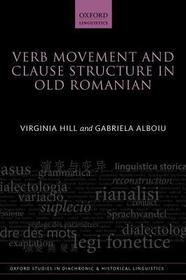
Verb Movement and Clause Structure in Old Romanian
Sorozatcím: Oxford Studies in Diachronic and Historical Linguistics; 18;
-
10% KEDVEZMÉNY?
- A kedvezmény csak az 'Értesítés a kedvenc témákról' hírlevelünk címzettjeinek rendeléseire érvényes.
- Kiadói listaár GBP 125.00
-
59 718 Ft (56 875 Ft + 5% áfa)
Az ár azért becsült, mert a rendelés pillanatában nem lehet pontosan tudni, hogy a beérkezéskor milyen lesz a forint árfolyama az adott termék eredeti devizájához képest. Ha a forint romlana, kissé többet, ha javulna, kissé kevesebbet kell majd fizetnie.
- Kedvezmény(ek) 10% (cc. 5 972 Ft off)
- Kedvezményes ár 53 747 Ft (51 188 Ft + 5% áfa)
Iratkozzon fel most és részesüljön kedvezőbb árainkból!
Feliratkozom
59 718 Ft

Beszerezhetőség
Megrendelésre a kiadó utánnyomja a könyvet. Rendelhető, de a szokásosnál kicsit lassabban érkezik meg.
Why don't you give exact delivery time?
A beszerzés időigényét az eddigi tapasztalatokra alapozva adjuk meg. Azért becsült, mert a terméket külföldről hozzuk be, így a kiadó kiszolgálásának pillanatnyi gyorsaságától is függ. A megadottnál gyorsabb és lassabb szállítás is elképzelhető, de mindent megteszünk, hogy Ön a lehető leghamarabb jusson hozzá a termékhez.
A termék adatai:
- Kiadó OUP Oxford
- Megjelenés dátuma 2016. január 21.
- ISBN 9780198736509
- Kötéstípus Keménykötés
- Terjedelem352 oldal
- Méret 234x166x24 mm
- Súly 644 g
- Nyelv angol 0
Kategóriák
Rövid leírás:
The book provides a formal analysis of root and complement clauses in Old Romanian, focussing on the combination of Balkan syntactic patterns and Romance morphology. It presents a new perspective on the manifestation of Balkan Sprachbund properties in the language, and on the nature of parametric differences in relation to other Romance languages.
TöbbHosszú leírás:
The book provides a formal analysis of root and complement clauses in Old Romanian. Virginia Hill and Gabriela Alboiu examine the combination of Balkan syntactic patterns such as generalized subjunctive complementation on the one hand, and the Romance morphology that supplies complementizers and grammatical mood forms on the other. The consequences of this mixed typology range from root clauses with non-finite verbs to split heads and repeated recycling in clausal complements. The book argues that discourse triggers at the left periphery are responsible for fluctuations in verb movement in finite clauses, while with gerunds and imperatives verb movement follows from functional constraints. It further argues that clausal complements to control and raising verbs systematically display the pattern of the Balkan subjunctive, and that the spell out of these clausal complements has been repeatedly recycled during the development of Romanian.
Verb Movement and Clause Structure in Old Romanian presents a new perspective on the manifestation of Balkan Sprachbund properties in the language, and on the nature of parametric differences in relation to other Romance languages. It provides a unified explanation for a range of constructions that have previously been treated as separate phenomena, and places diachronic changes in Romanian in a wider context.
This book focuses on a stage in the history of the language that has not benefited so far from a thorough investigation within a formal theoretical framework. It is extremely valuable both in terms of its empirical coverage but also in terms of the subtlety with which the analysis captures unifying patterns for some Old Romanian facts that would otherwise seem disconnected.
Tartalomjegyzék:
Acknowledgements
Abbreviations in glosses
Preface: Medieval Romania and Old Romanian
Research background and theoretical framework
Subjects, complementizers, and clitics
High verb movement in finite clauses
Imperative clauses
Gerund clauses
De-indicatives: A faithful replica of the Balkan subjunctive
A-infinitive: A version of the Balkan subjunctive
Să subjunctives: Another version of the Balkan subjunctive
Supine clauses: On the road to balkanization
Conclusions and remarks on the recycling of the Balkan subjunctive
References
Index

