

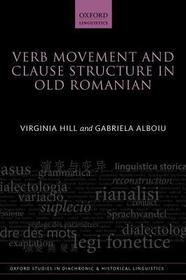
Verb Movement and Clause Structure in Old Romanian
Series: Oxford Studies in Diachronic and Historical Linguistics; 18;
- Publisher's listprice GBP 125.00
-
59 718 Ft (56 875 Ft + 5% VAT)
The price is estimated because at the time of ordering we do not know what conversion rates will apply to HUF / product currency when the book arrives. In case HUF is weaker, the price increases slightly, in case HUF is stronger, the price goes lower slightly.
- Discount 10% (cc. 5 972 Ft off)
- Discounted price 53 747 Ft (51 188 Ft + 5% VAT)
Subcribe now and take benefit of a favourable price.
Subscribe
59 718 Ft

Availability
printed on demand
Why don't you give exact delivery time?
Delivery time is estimated on our previous experiences. We give estimations only, because we order from outside Hungary, and the delivery time mainly depends on how quickly the publisher supplies the book. Faster or slower deliveries both happen, but we do our best to supply as quickly as possible.
Product details:
- Publisher OUP Oxford
- Date of Publication 21 January 2016
- ISBN 9780198736509
- Binding Hardback
- No. of pages352 pages
- Size 234x166x24 mm
- Weight 644 g
- Language English 0
Categories
Short description:
The book provides a formal analysis of root and complement clauses in Old Romanian, focussing on the combination of Balkan syntactic patterns and Romance morphology. It presents a new perspective on the manifestation of Balkan Sprachbund properties in the language, and on the nature of parametric differences in relation to other Romance languages.
MoreLong description:
The book provides a formal analysis of root and complement clauses in Old Romanian. Virginia Hill and Gabriela Alboiu examine the combination of Balkan syntactic patterns such as generalized subjunctive complementation on the one hand, and the Romance morphology that supplies complementizers and grammatical mood forms on the other. The consequences of this mixed typology range from root clauses with non-finite verbs to split heads and repeated recycling in clausal complements. The book argues that discourse triggers at the left periphery are responsible for fluctuations in verb movement in finite clauses, while with gerunds and imperatives verb movement follows from functional constraints. It further argues that clausal complements to control and raising verbs systematically display the pattern of the Balkan subjunctive, and that the spell out of these clausal complements has been repeatedly recycled during the development of Romanian.
Verb Movement and Clause Structure in Old Romanian presents a new perspective on the manifestation of Balkan Sprachbund properties in the language, and on the nature of parametric differences in relation to other Romance languages. It provides a unified explanation for a range of constructions that have previously been treated as separate phenomena, and places diachronic changes in Romanian in a wider context.
This book focuses on a stage in the history of the language that has not benefited so far from a thorough investigation within a formal theoretical framework. It is extremely valuable both in terms of its empirical coverage but also in terms of the subtlety with which the analysis captures unifying patterns for some Old Romanian facts that would otherwise seem disconnected.
Table of Contents:
Acknowledgements
Abbreviations in glosses
Preface: Medieval Romania and Old Romanian
Research background and theoretical framework
Subjects, complementizers, and clitics
High verb movement in finite clauses
Imperative clauses
Gerund clauses
De-indicatives: A faithful replica of the Balkan subjunctive
A-infinitive: A version of the Balkan subjunctive
Să subjunctives: Another version of the Balkan subjunctive
Supine clauses: On the road to balkanization
Conclusions and remarks on the recycling of the Balkan subjunctive
References
Index

