

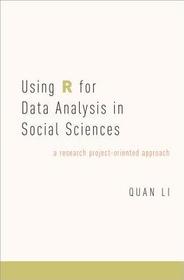
Using R for Data Analysis in Social Sciences
A Research Project-Oriented Approach
-
10% KEDVEZMÉNY?
- A kedvezmény csak az 'Értesítés a kedvenc témákról' hírlevelünk címzettjeinek rendeléseire érvényes.
- Kiadói listaár GBP 122.50
-
55 308 Ft (52 675 Ft + 5% áfa)
Az ár azért becsült, mert a rendelés pillanatában nem lehet pontosan tudni, hogy a beérkezéskor milyen lesz a forint árfolyama az adott termék eredeti devizájához képest. Ha a forint romlana, kissé többet, ha javulna, kissé kevesebbet kell majd fizetnie.
- Kedvezmény(ek) 10% (kb. 5 530 Ft)
- Kedvezményes ár 49 778 Ft (47 408 Ft + 5% áfa)
Iratkozzon fel most és részesüljön kedvezőbb árainkból!
Feliratkozom
55 308 Ft

Beszerezhetőség
Megrendelésre a kiadó utánnyomja a könyvet. Rendelhető, de a szokásosnál kicsit lassabban érkezik meg.
Why don't you give exact delivery time?
A beszerzés időigényét az eddigi tapasztalatokra alapozva adjuk meg. Azért becsült, mert a terméket külföldről hozzuk be, így a kiadó kiszolgálásának pillanatnyi gyorsaságától is függ. A megadottnál gyorsabb és lassabb szállítás is elképzelhető, de mindent megteszünk, hogy Ön a lehető leghamarabb jusson hozzá a termékhez.
A termék adatai:
- Kiadó OUP USA
- Megjelenés dátuma 2018. július 5.
- ISBN 9780190656218
- Kötéstípus Keménykötés
- Terjedelem366 oldal
- Méret 163x236x25 mm
- Súly 652 g
- Nyelv angol 0
Kategóriák
Rövid leírás:
Using R for Data Analysis in Social Sciences offers a step-by-step guide on using free software R to conduct and reproduce published quantitative analysis. It walks readers through data preparation, visualization, analysis, and reporting. Test-used in undergraduate classes and student self-study, it is appropriate for any introductory course on R, data analysis, and empirical social-scientific research.
TöbbHosszú leírás:
Statistical analysis is common in the social sciences, and among the more popular programs is R. This book provides a foundation for undergraduate and graduate students in the social sciences on how to use R to manage, visualize, and analyze data. The focus is on how to address substantive questions with data analysis and replicate published findings.
Using R for Data Analysis in Social Sciences adopts a minimalist approach and covers only the most important functions and skills in R to conduct reproducible research. It emphasizes the practical needs of students using R by showing how to import, inspect, and manage data, understand the logic of statistical inference, visualize data and findings via histograms, boxplots, scatterplots, and diagnostic plots, and analyze data using one-sample t-test, difference-of-means test, covariance, correlation, ordinary least squares (OLS) regression, and model assumption diagnostics. It also demonstrates how to replicate the findings in published journal articles and diagnose model assumption violations. Because the book integrates R programming, the logic and steps of statistical inference, and the process of empirical social scientific research in a highly accessible and structured fashion, it is appropriate for any introductory course on R, data analysis, and empirical social-scientific research.
Tartalomjegyzék:
List of Figures
List of Tables
1. Learn about R and Write First Toy Programs
2. Get Data Ready: Import, Inspect, and Prepare Data
3. One-Sample and Difference of Means Tests
4. Covariance and Correlation
5. Regression Analysis
6. Regression Diagnostics and Sensitivity Analysis
7. Replicate Findings in Published Analyses
8. Appendix: A Brief Introduction to Analyzing Discrete Data

