

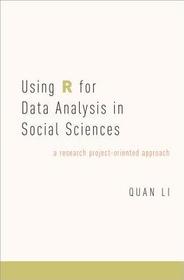
Using R for Data Analysis in Social Sciences
A Research Project-Oriented Approach
- Publisher's listprice GBP 122.50
-
55 308 Ft (52 675 Ft + 5% VAT)
The price is estimated because at the time of ordering we do not know what conversion rates will apply to HUF / product currency when the book arrives. In case HUF is weaker, the price increases slightly, in case HUF is stronger, the price goes lower slightly.
- Discount 10% (cc. 5 530 Ft off)
- Discounted price 49 778 Ft (47 408 Ft + 5% VAT)
Subcribe now and take benefit of a favourable price.
Subscribe
55 308 Ft

Availability
printed on demand
Why don't you give exact delivery time?
Delivery time is estimated on our previous experiences. We give estimations only, because we order from outside Hungary, and the delivery time mainly depends on how quickly the publisher supplies the book. Faster or slower deliveries both happen, but we do our best to supply as quickly as possible.
Product details:
- Publisher OUP USA
- Date of Publication 5 July 2018
- ISBN 9780190656218
- Binding Hardback
- No. of pages366 pages
- Size 163x236x25 mm
- Weight 652 g
- Language English 0
Categories
Short description:
Using R for Data Analysis in Social Sciences offers a step-by-step guide on using free software R to conduct and reproduce published quantitative analysis. It walks readers through data preparation, visualization, analysis, and reporting. Test-used in undergraduate classes and student self-study, it is appropriate for any introductory course on R, data analysis, and empirical social-scientific research.
MoreLong description:
Statistical analysis is common in the social sciences, and among the more popular programs is R. This book provides a foundation for undergraduate and graduate students in the social sciences on how to use R to manage, visualize, and analyze data. The focus is on how to address substantive questions with data analysis and replicate published findings.
Using R for Data Analysis in Social Sciences adopts a minimalist approach and covers only the most important functions and skills in R to conduct reproducible research. It emphasizes the practical needs of students using R by showing how to import, inspect, and manage data, understand the logic of statistical inference, visualize data and findings via histograms, boxplots, scatterplots, and diagnostic plots, and analyze data using one-sample t-test, difference-of-means test, covariance, correlation, ordinary least squares (OLS) regression, and model assumption diagnostics. It also demonstrates how to replicate the findings in published journal articles and diagnose model assumption violations. Because the book integrates R programming, the logic and steps of statistical inference, and the process of empirical social scientific research in a highly accessible and structured fashion, it is appropriate for any introductory course on R, data analysis, and empirical social-scientific research.
Table of Contents:
List of Figures
List of Tables
1. Learn about R and Write First Toy Programs
2. Get Data Ready: Import, Inspect, and Prepare Data
3. One-Sample and Difference of Means Tests
4. Covariance and Correlation
5. Regression Analysis
6. Regression Diagnostics and Sensitivity Analysis
7. Replicate Findings in Published Analyses
8. Appendix: A Brief Introduction to Analyzing Discrete Data

