

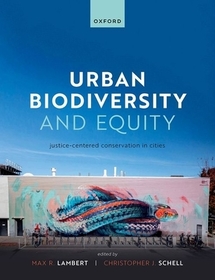
Urban Biodiversity and Equity
Justice-Centered Conservation in Cities
-
10% KEDVEZMÉNY?
- A kedvezmény csak az 'Értesítés a kedvenc témákról' hírlevelünk címzettjeinek rendeléseire érvényes.
- Kiadói listaár GBP 110.00
-
49 665 Ft (47 300 Ft + 5% áfa)
Az ár azért becsült, mert a rendelés pillanatában nem lehet pontosan tudni, hogy a beérkezéskor milyen lesz a forint árfolyama az adott termék eredeti devizájához képest. Ha a forint romlana, kissé többet, ha javulna, kissé kevesebbet kell majd fizetnie.
- Kedvezmény(ek) 10% (kb. 4 967 Ft)
- Kedvezményes ár 44 699 Ft (42 570 Ft + 5% áfa)
Iratkozzon fel most és részesüljön kedvezőbb árainkból!
Feliratkozom
49 665 Ft

Beszerezhetőség
Becsült beszerzési idő: A Prosperónál jelenleg nincsen raktáron, de a kiadónál igen. Beszerzés kb. 3-5 hét..
A Prosperónál jelenleg nincsen raktáron.
Why don't you give exact delivery time?
A beszerzés időigényét az eddigi tapasztalatokra alapozva adjuk meg. Azért becsült, mert a terméket külföldről hozzuk be, így a kiadó kiszolgálásának pillanatnyi gyorsaságától is függ. A megadottnál gyorsabb és lassabb szállítás is elképzelhető, de mindent megteszünk, hogy Ön a lehető leghamarabb jusson hozzá a termékhez.
A termék adatai:
- Kiadó OUP Oxford
- Megjelenés dátuma 2023. szeptember 26.
- ISBN 9780198877271
- Kötéstípus Keménykötés
- Terjedelem304 oldal
- Méret 253x193x20 mm
- Súly 828 g
- Nyelv angol
- Illusztrációk Colour line drawings and half tones 424
Kategóriák
Rövid leírás:
Urban systems have a long history and continued legacy of social inequality that govern how cities are both built and managed. This novel text not only highlights these connections, but also illustrates the interdisciplinary approaches needed for advancing a new, justice-centred approach to nature conservation.
TöbbHosszú leírás:
This advanced textbook moves beyond a basic scientific comprehension of urban ecosystems to understand the essential details of how scientists, policy makers, and practitioners develop solutions to effectively manage urban biodiversity. Such efforts necessitate unravelling the complex components that bolster or constrain biodiversity including human-wildlife interactions, resource availability, climate fluctuations, novel species relationships, and landscape heterogeneity. However, key to an understanding of these processes is also recognizing the tremendous social variation inherent within and across urban areas. The diversity of urban human communities fundamentally shapes how society designs, builds, and manages urban landscapes. This means that urban environmental management unavoidably must account for human social variation. Unfortunately, urban systems have a history and continued legacy of social inequality (e.g., systemic racism and classism) that govern how cities are both built and managed. This novel text not only highlights these connections, but also illustrates the interdisciplinary approaches needed for advancing a new, justice-centred approach to nature conservation.
Urban Biodiversity and Equity is suitable for graduate level students and professional researchers from both natural and social science disciplines studying the ecology, conservation, and management of urban environments and their biodiversity. It will also be of relevance and use to a broader audience of urban ecologists, urban planners, and urban wildlife practitioners.
Tartalomjegyzék:
The Imperative of Urban Conservation
Section 1: Urban Nature's Social Fabric
Escaping the Practice of Exclusion: Conservation, Greenspace, and Urban Planning in the Age of Environmental Justice
Human Motivations and Constraints in Urban Conservation
Conservation on the Urban Fringe: Sustaining Biodiversity and Advancing Equity in Suburban Ecosystems
Portland's Conservation Organizations: Acknowledging Racial Inequity and Responding with Community-Informed Solutions
Section 2: Innovative Approaches for Understanding and Prioritizing Equitable Urban Conservation
The Role of Urban Tree Canopies in Environmental Justice and Conserving Biodiversity
Participatory Science for Equitable Urban Biodiversity Research and Practice
Conservation Through Multi-City Ecological Networks
Molecular Methods Through an Urban Social-Ecological Focus
Urban Flagship Umbrella Species and Slender Lorises as an Example for Urban Conservation
Animal Behavior, Cognition, and Human-Wildlife Interactions in Urban Areas
Section 3: Emergent Urban Planning and Management Frameworks for Addressing Societal and Conservation Goals
Urban Places Create Unique Health Spaces for Wildlife, People, and the Environment
Developing a Toolbox for Urban Biodiversity Conservation
Making Nature's City: An Applied Science Framework to Guide Evaluation and Planning for Urban Biodiversity Conservation
Conclusions
Biodiversity for the People: Future Directions for Urban Biodiversity Conservation

