

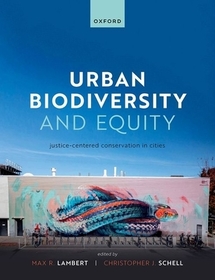
Urban Biodiversity and Equity
Justice-Centered Conservation in Cities
- Publisher's listprice GBP 110.00
-
49 665 Ft (47 300 Ft + 5% VAT)
The price is estimated because at the time of ordering we do not know what conversion rates will apply to HUF / product currency when the book arrives. In case HUF is weaker, the price increases slightly, in case HUF is stronger, the price goes lower slightly.
- Discount 10% (cc. 4 967 Ft off)
- Discounted price 44 699 Ft (42 570 Ft + 5% VAT)
Subcribe now and take benefit of a favourable price.
Subscribe
49 665 Ft

Availability
Estimated delivery time: In stock at the publisher, but not at Prospero's office. Delivery time approx. 3-5 weeks.
Not in stock at Prospero.
Why don't you give exact delivery time?
Delivery time is estimated on our previous experiences. We give estimations only, because we order from outside Hungary, and the delivery time mainly depends on how quickly the publisher supplies the book. Faster or slower deliveries both happen, but we do our best to supply as quickly as possible.
Product details:
- Publisher OUP Oxford
- Date of Publication 26 September 2023
- ISBN 9780198877271
- Binding Hardback
- No. of pages304 pages
- Size 253x193x20 mm
- Weight 828 g
- Language English
- Illustrations Colour line drawings and half tones 424
Categories
Short description:
Urban systems have a long history and continued legacy of social inequality that govern how cities are both built and managed. This novel text not only highlights these connections, but also illustrates the interdisciplinary approaches needed for advancing a new, justice-centred approach to nature conservation.
MoreLong description:
This advanced textbook moves beyond a basic scientific comprehension of urban ecosystems to understand the essential details of how scientists, policy makers, and practitioners develop solutions to effectively manage urban biodiversity. Such efforts necessitate unravelling the complex components that bolster or constrain biodiversity including human-wildlife interactions, resource availability, climate fluctuations, novel species relationships, and landscape heterogeneity. However, key to an understanding of these processes is also recognizing the tremendous social variation inherent within and across urban areas. The diversity of urban human communities fundamentally shapes how society designs, builds, and manages urban landscapes. This means that urban environmental management unavoidably must account for human social variation. Unfortunately, urban systems have a history and continued legacy of social inequality (e.g., systemic racism and classism) that govern how cities are both built and managed. This novel text not only highlights these connections, but also illustrates the interdisciplinary approaches needed for advancing a new, justice-centred approach to nature conservation.
Urban Biodiversity and Equity is suitable for graduate level students and professional researchers from both natural and social science disciplines studying the ecology, conservation, and management of urban environments and their biodiversity. It will also be of relevance and use to a broader audience of urban ecologists, urban planners, and urban wildlife practitioners.
Table of Contents:
The Imperative of Urban Conservation
Section 1: Urban Nature's Social Fabric
Escaping the Practice of Exclusion: Conservation, Greenspace, and Urban Planning in the Age of Environmental Justice
Human Motivations and Constraints in Urban Conservation
Conservation on the Urban Fringe: Sustaining Biodiversity and Advancing Equity in Suburban Ecosystems
Portland's Conservation Organizations: Acknowledging Racial Inequity and Responding with Community-Informed Solutions
Section 2: Innovative Approaches for Understanding and Prioritizing Equitable Urban Conservation
The Role of Urban Tree Canopies in Environmental Justice and Conserving Biodiversity
Participatory Science for Equitable Urban Biodiversity Research and Practice
Conservation Through Multi-City Ecological Networks
Molecular Methods Through an Urban Social-Ecological Focus
Urban Flagship Umbrella Species and Slender Lorises as an Example for Urban Conservation
Animal Behavior, Cognition, and Human-Wildlife Interactions in Urban Areas
Section 3: Emergent Urban Planning and Management Frameworks for Addressing Societal and Conservation Goals
Urban Places Create Unique Health Spaces for Wildlife, People, and the Environment
Developing a Toolbox for Urban Biodiversity Conservation
Making Nature's City: An Applied Science Framework to Guide Evaluation and Planning for Urban Biodiversity Conservation
Conclusions
Biodiversity for the People: Future Directions for Urban Biodiversity Conservation

