

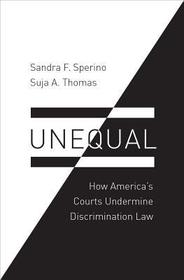
Unequal
How America's Courts Undermine Discrimination Law
Sorozatcím: Law and Current Events Masters;
-
10% KEDVEZMÉNY?
- A kedvezmény csak az 'Értesítés a kedvenc témákról' hírlevelünk címzettjeinek rendeléseire érvényes.
- Kiadói listaár GBP 38.99
-
17 603 Ft (16 765 Ft + 5% áfa)
Az ár azért becsült, mert a rendelés pillanatában nem lehet pontosan tudni, hogy a beérkezéskor milyen lesz a forint árfolyama az adott termék eredeti devizájához képest. Ha a forint romlana, kissé többet, ha javulna, kissé kevesebbet kell majd fizetnie.
- Kedvezmény(ek) 10% (kb. 1 760 Ft)
- Kedvezményes ár 15 843 Ft (15 089 Ft + 5% áfa)
Iratkozzon fel most és részesüljön kedvezőbb árainkból!
Feliratkozom
17 603 Ft

Beszerezhetőség
Megrendelésre a kiadó utánnyomja a könyvet. Rendelhető, de a szokásosnál kicsit lassabban érkezik meg.
Why don't you give exact delivery time?
A beszerzés időigényét az eddigi tapasztalatokra alapozva adjuk meg. Azért becsült, mert a terméket külföldről hozzuk be, így a kiadó kiszolgálásának pillanatnyi gyorsaságától is függ. A megadottnál gyorsabb és lassabb szállítás is elképzelhető, de mindent megteszünk, hogy Ön a lehető leghamarabb jusson hozzá a termékhez.
A termék adatai:
- Kiadó OUP USA
- Megjelenés dátuma 2017. június 15.
- ISBN 9780190278380
- Kötéstípus Keménykötés
- Terjedelem232 oldal
- Méret 236x160x22 mm
- Súly 440 g
- Nyelv angol 0
Kategóriák
Rövid leírás:
Most Americans assume that that employees alleging workplace discrimination face the same legal system as other litigants. However, employment discrimination cases have fared increasingly poorly in the courts and have come to operate in a fundamentally different legal system than other claims. In Unequal, Sandra F. Sperino and Suja A. Thomas provide an authoritative account of how our legal system evolved into an institution that is inherently biased against workers making rights claims.
TöbbHosszú leírás:
It is no secret that since the 1980s, American workers have lost power vis-a-vis employers through the well-chronicled steep decline in private sector unionization. American workers have also lost power in other ways. Those alleging employment discrimination have fared increasingly poorly in the courts. In recent years, judges have dismissed scores of cases in which workers presented evidence that supervisors referred to them using racial or gender slurs. In one federal district court, judges dismissed more than 80 percent of the race discrimination cases filed over a year. And when juries return verdicts in favor of employees, judges often second guess those verdicts, finding ways to nullify the jury's verdict and rule in favor of the employer.
Most Americans assume that that an employee alleging workplace discrimination faces the same legal system as other litigants. After all, we do not usually think that legal rules vary depending upon the type of claim brought. The employment law scholars Sandra A. Sperino and Suja A. Thomas show in Unequal that our assumptions are wrong. Over the course of the last half century, employment discrimination claims have come to operate in a fundamentally different legal system than other claims. It is in many respects a parallel universe, one in which the legal system systematically favors employers over employees. A host of procedural, evidentiary, and substantive mechanisms serve as barriers for employees, making it extremely difficult for them to access the courts. Moreover, these mechanisms make it fairly easy for judges to dismiss a case prior to trial. Americans are unaware of how the system operates partly because they think that race and gender discrimination are in the process of fading away. But such discrimination still happens in the workplace, and workers now have little recourse to fight it legally. By tracing the modern history of employment discrimination, Sperino and Thomas provide an authoritative account of how our legal system evolved into an institution that is inherently biased against workers making rights claims.
This is must-read for all who care about workplace fairness and realizing the promise of our nation's civil rights laws.
Tartalomjegyzék:
Table of Contents
Preface and Acknowledgments
Chapter 1: Introduction
Chapter 2: The Ways Judges Dismiss Cases
Chapter 3. How Discrimination Disappears
Chapter 4: Down the Rabbit Hole
Chapter 5. Causation
Chapter 6. Frameworks
Chapter 7. Politics
Chapter 8: Fakers and Floodgates
Chapter 9: Why Workers Lose
Chapter 10: The Future of Discrimination Law
Notes

