

- Publisher's listprice GBP 38.99
-
17 603 Ft (16 765 Ft + 5% VAT)
The price is estimated because at the time of ordering we do not know what conversion rates will apply to HUF / product currency when the book arrives. In case HUF is weaker, the price increases slightly, in case HUF is stronger, the price goes lower slightly.
- Discount 10% (cc. 1 760 Ft off)
- Discounted price 15 843 Ft (15 089 Ft + 5% VAT)
Subcribe now and take benefit of a favourable price.
Subscribe
17 603 Ft

Availability
printed on demand
Why don't you give exact delivery time?
Delivery time is estimated on our previous experiences. We give estimations only, because we order from outside Hungary, and the delivery time mainly depends on how quickly the publisher supplies the book. Faster or slower deliveries both happen, but we do our best to supply as quickly as possible.
Product details:
- Publisher OUP USA
- Date of Publication 15 June 2017
- ISBN 9780190278380
- Binding Hardback
- No. of pages232 pages
- Size 236x160x22 mm
- Weight 440 g
- Language English 0
Categories
Short description:
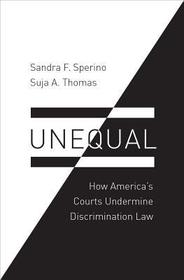
Most Americans assume that that employees alleging workplace discrimination face the same legal system as other litigants. However, employment discrimination cases have fared increasingly poorly in the courts and have come to operate in a fundamentally different legal system than other claims. In Unequal, Sandra F. Sperino and Suja A. Thomas provide an authoritative account of how our legal system evolved into an institution that is inherently biased against workers making rights claims.
MoreLong description:
It is no secret that since the 1980s, American workers have lost power vis-a-vis employers through the well-chronicled steep decline in private sector unionization. American workers have also lost power in other ways. Those alleging employment discrimination have fared increasingly poorly in the courts. In recent years, judges have dismissed scores of cases in which workers presented evidence that supervisors referred to them using racial or gender slurs. In one federal district court, judges dismissed more than 80 percent of the race discrimination cases filed over a year. And when juries return verdicts in favor of employees, judges often second guess those verdicts, finding ways to nullify the jury's verdict and rule in favor of the employer.
Most Americans assume that that an employee alleging workplace discrimination faces the same legal system as other litigants. After all, we do not usually think that legal rules vary depending upon the type of claim brought. The employment law scholars Sandra A. Sperino and Suja A. Thomas show in Unequal that our assumptions are wrong. Over the course of the last half century, employment discrimination claims have come to operate in a fundamentally different legal system than other claims. It is in many respects a parallel universe, one in which the legal system systematically favors employers over employees. A host of procedural, evidentiary, and substantive mechanisms serve as barriers for employees, making it extremely difficult for them to access the courts. Moreover, these mechanisms make it fairly easy for judges to dismiss a case prior to trial. Americans are unaware of how the system operates partly because they think that race and gender discrimination are in the process of fading away. But such discrimination still happens in the workplace, and workers now have little recourse to fight it legally. By tracing the modern history of employment discrimination, Sperino and Thomas provide an authoritative account of how our legal system evolved into an institution that is inherently biased against workers making rights claims.
This is must-read for all who care about workplace fairness and realizing the promise of our nation's civil rights laws.
Table of Contents:
Table of Contents
Preface and Acknowledgments
Chapter 1: Introduction
Chapter 2: The Ways Judges Dismiss Cases
Chapter 3. How Discrimination Disappears
Chapter 4: Down the Rabbit Hole
Chapter 5. Causation
Chapter 6. Frameworks
Chapter 7. Politics
Chapter 8: Fakers and Floodgates
Chapter 9: Why Workers Lose
Chapter 10: The Future of Discrimination Law
Notes

