

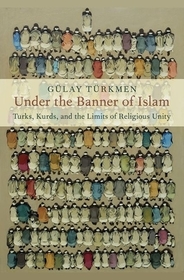
Under the Banner of Islam
Turks, Kurds, and the Limits of Religious Unity
Sorozatcím: Religion and Global Politics;
-
10% KEDVEZMÉNY?
- A kedvezmény csak az 'Értesítés a kedvenc témákról' hírlevelünk címzettjeinek rendeléseire érvényes.
- Kiadói listaár GBP 86.00
-
38 829 Ft (36 980 Ft + 5% áfa)
Az ár azért becsült, mert a rendelés pillanatában nem lehet pontosan tudni, hogy a beérkezéskor milyen lesz a forint árfolyama az adott termék eredeti devizájához képest. Ha a forint romlana, kissé többet, ha javulna, kissé kevesebbet kell majd fizetnie.
- Kedvezmény(ek) 10% (cc. 3 883 Ft off)
- Kedvezményes ár 34 946 Ft (33 282 Ft + 5% áfa)
Iratkozzon fel most és részesüljön kedvezőbb árainkból!
Feliratkozom
38 829 Ft

Beszerezhetőség
Megrendelésre a kiadó utánnyomja a könyvet. Rendelhető, de a szokásosnál kicsit lassabban érkezik meg.
Why don't you give exact delivery time?
A beszerzés időigényét az eddigi tapasztalatokra alapozva adjuk meg. Azért becsült, mert a terméket külföldről hozzuk be, így a kiadó kiszolgálásának pillanatnyi gyorsaságától is függ. A megadottnál gyorsabb és lassabb szállítás is elképzelhető, de mindent megteszünk, hogy Ön a lehető leghamarabb jusson hozzá a termékhez.
A termék adatai:
- Kiadó OUP USA
- Megjelenés dátuma 2021. március 31.
- ISBN 9780197511817
- Kötéstípus Keménykötés
- Terjedelem204 oldal
- Méret 155x239x22 mm
- Súly 431 g
- Nyelv angol 75
Kategóriák
Rövid leírás:
Sunni Islam has played an ambivalent role in Turkey's Kurdish conflict--both as a conflict resolution tool and as a tool of resistance. Under the Banner of Islam uses Turkey as a case study to understand how religious, ethnic, and national identities converge in ethnic conflicts between co-religionists. Gülay Türkmen asks a question that informs the way we understand religiously homogeneous ethnic conflicts today: Is it possible for religion to act as a resolution tool in these often-violent conflicts?
TöbbHosszú leírás:
Sunni Islam has played an ambivalent role in Turkey's Kurdish conflict--both as a conflict resolution tool and as a tool of resistance. Under the Banner of Islam uses Turkey as a case study to understand how religious, ethnic, and national identities converge in ethnic conflicts between co-religionists. Gülay Türkmen asks a question that informs the way we understand religiously homogeneous ethnic conflicts today: Is it possible for religion to act as a resolution tool in these often-violent conflicts?
In search for answers to this question, in Under the Banner of Islam, Türkmen journeys into the inner circles of religious elites from different backgrounds: non-state-appointed local Kurdish meles, state-appointed Kurdish and Turkish imams, heads of religious NGOs, and members of religious orders. Blending interview data with a detailed historical analysis that goes back as far as the nineteenth century, she argues that the strength of Turkish and Kurdish nationalisms, the symbiotic relationship between Turkey's religious and political fields, the religious elites' varying conceptualizations of religious and ethnic identities, and the recent political developments in the region (particularly in Syria) all contribute to the complex role religion plays in the Kurdish conflict in Turkey.
Under the Banner of Islam is a specific story of religion, ethnicity, and nationalism in Turkey's Kurdish conflict, but it also tracks a broader narrative of how ethnic and religious identities are negotiated when resolving conflicts.
This is a good, concise account of the dilemma Turks and Kurds face in Turkey. Recommended. Advanced undergraduates through faculty.
Tartalomjegyzék:
Prologue
Introduction
"Under the banner of Islam"
"The ambivalence of the sacred": Religion and conflict resolution
The porous borders of religion and ethnicity
The shifting borders of religious and political fields
Chapter 1
"Green Kemalism": The evolving role of Islam in the Kurdish conflict
Kurdish revolts in the late Ottoman period: Against centralization?
Kurdish revolts in the early Republican period: Kurdish-Islamic Synthesis?
The secularization of the Kurdish movement: 1950-1978
Bringing Islam back in: 1990-2002
Chapter 2
"Islam as cement": The way out?
"There is only one nation and that is the nation of Abraham"
The ummah that never was
AKP's Kurdish policy: Neo-Ottoman Pan-Islamism
Chapter 3
Muslim-Kurds: The case for religio-ethnic identity
"God could have created us all the same": Religious roots of ethnicity
Kurdish Islam embodied: Civil Friday Prayers
Turkey's religious field in the 2000s: A Bourdieusian analysis
Islam as a tool of resistance
Chapter 4
"Only Turks can lead a Muslim union": The case for ethno-religious identity
Ottomanism, Islamism, Turkism: Birth pangs of Turkish nationalism
Turkish History Thesis and the Turkification of Islam
Turkey's pending dilemma: The Turkish-Islamic Synthesis
AKP's transformation: "From the Kurd's Qur'an to the Turk's flag"
Conclusion:
United in religion, divided by ethnicity?
The way forward: Whither Kurdish conflict?
Appendix: Methodology
Notes
Index

