

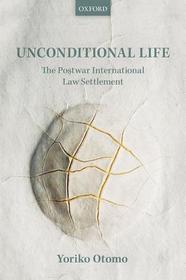
Unconditional Life
The Postwar International Law Settlement
-
10% KEDVEZMÉNY?
- A kedvezmény csak az 'Értesítés a kedvenc témákról' hírlevelünk címzettjeinek rendeléseire érvényes.
- Kiadói listaár GBP 91.00
-
41 086 Ft (39 130 Ft + 5% áfa)
Az ár azért becsült, mert a rendelés pillanatában nem lehet pontosan tudni, hogy a beérkezéskor milyen lesz a forint árfolyama az adott termék eredeti devizájához képest. Ha a forint romlana, kissé többet, ha javulna, kissé kevesebbet kell majd fizetnie.
- Kedvezmény(ek) 10% (kb. 4 108 Ft)
- Kedvezményes ár 36 978 Ft (35 217 Ft + 5% áfa)
Iratkozzon fel most és részesüljön kedvezőbb árainkból!
Feliratkozom
41 086 Ft

Beszerezhetőség
Megrendelésre a kiadó utánnyomja a könyvet. Rendelhető, de a szokásosnál kicsit lassabban érkezik meg.
Why don't you give exact delivery time?
A beszerzés időigényét az eddigi tapasztalatokra alapozva adjuk meg. Azért becsült, mert a terméket külföldről hozzuk be, így a kiadó kiszolgálásának pillanatnyi gyorsaságától is függ. A megadottnál gyorsabb és lassabb szállítás is elképzelhető, de mindent megteszünk, hogy Ön a lehető leghamarabb jusson hozzá a termékhez.
A termék adatai:
- Kiadó OUP Oxford
- Megjelenés dátuma 2016. május 19.
- ISBN 9780198733812
- Kötéstípus Keménykötés
- Terjedelem212 oldal
- Méret 222x149x18 mm
- Súly 404 g
- Nyelv angol 0
Kategóriák
Rövid leírás:
Looking at how international law regulates, and is itself influenced by, technology and risk, this book illustrates how and why international law has been unable to properly deal with large-scale technological risk. Through delving into its nature, international law is shown itself to be a technology.
TöbbHosszú leírás:
Drawing on philosophy, history, and critical theory, Unconditional Life introduces a new perspective on the significance of post-war international law developments. The book examines the public discourse regarding technological risk in World War II texts of unconditional surrender, in the World Trade Organisation's EC-Biotech dispute, and in the International Court of Justices' Nuclear Weapons Advisory Opinion. The volume describes international law in terms of its management of, and relation to, the risks associated with technological innovation in war and in trade. It proposes that international law, too, is itself a kind of technology: one intended to manage the material and existential risks inherent in the creation of a new international, postcolonial, political community emerging out of the Second World War. Members of this community are imagined to possess a universal quality: humanness, which itself is underscored by a power of invention. Yoriko Otomo demonstrates how international lawyers' inability to adjudicate questions of large-scale technological risk is due to the competing and intractable claims of international law.
Offering a feminist analysis of the political economy that has created this crisis of governance, the book provides a way of understanding the structural inequities that will need to be addressed if international law is to remain a relevant forum for the adjudication of war and trade into the 21st century.
Tartalomjegyzék:
Introduction
Reading International Law
Risk, Technology, and the State
Where the Danger Is, Grows the Saving Power Also
Atomic Age
Unconditional Life
The Human's Bodies
Conclusion

