

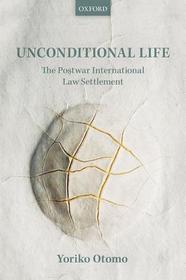
Unconditional Life
The Postwar International Law Settlement
- Publisher's listprice GBP 91.00
-
41 086 Ft (39 130 Ft + 5% VAT)
The price is estimated because at the time of ordering we do not know what conversion rates will apply to HUF / product currency when the book arrives. In case HUF is weaker, the price increases slightly, in case HUF is stronger, the price goes lower slightly.
- Discount 10% (cc. 4 108 Ft off)
- Discounted price 36 978 Ft (35 217 Ft + 5% VAT)
Subcribe now and take benefit of a favourable price.
Subscribe
41 086 Ft

Availability
printed on demand
Why don't you give exact delivery time?
Delivery time is estimated on our previous experiences. We give estimations only, because we order from outside Hungary, and the delivery time mainly depends on how quickly the publisher supplies the book. Faster or slower deliveries both happen, but we do our best to supply as quickly as possible.
Product details:
- Publisher OUP Oxford
- Date of Publication 19 May 2016
- ISBN 9780198733812
- Binding Hardback
- No. of pages212 pages
- Size 222x149x18 mm
- Weight 404 g
- Language English 0
Categories
Short description:
Looking at how international law regulates, and is itself influenced by, technology and risk, this book illustrates how and why international law has been unable to properly deal with large-scale technological risk. Through delving into its nature, international law is shown itself to be a technology.
MoreLong description:
Drawing on philosophy, history, and critical theory, Unconditional Life introduces a new perspective on the significance of post-war international law developments. The book examines the public discourse regarding technological risk in World War II texts of unconditional surrender, in the World Trade Organisation's EC-Biotech dispute, and in the International Court of Justices' Nuclear Weapons Advisory Opinion. The volume describes international law in terms of its management of, and relation to, the risks associated with technological innovation in war and in trade. It proposes that international law, too, is itself a kind of technology: one intended to manage the material and existential risks inherent in the creation of a new international, postcolonial, political community emerging out of the Second World War. Members of this community are imagined to possess a universal quality: humanness, which itself is underscored by a power of invention. Yoriko Otomo demonstrates how international lawyers' inability to adjudicate questions of large-scale technological risk is due to the competing and intractable claims of international law.
Offering a feminist analysis of the political economy that has created this crisis of governance, the book provides a way of understanding the structural inequities that will need to be addressed if international law is to remain a relevant forum for the adjudication of war and trade into the 21st century.
Table of Contents:
Introduction
Reading International Law
Risk, Technology, and the State
Where the Danger Is, Grows the Saving Power Also
Atomic Age
Unconditional Life
The Human's Bodies
Conclusion

