

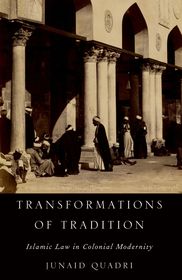
Transformations of Tradition
Islamic Law in Colonial Modernity
-
10% KEDVEZMÉNY?
- A kedvezmény csak az 'Értesítés a kedvenc témákról' hírlevelünk címzettjeinek rendeléseire érvényes.
- Kiadói listaár GBP 24.49
-
11 700 Ft (11 142 Ft + 5% áfa)
Az ár azért becsült, mert a rendelés pillanatában nem lehet pontosan tudni, hogy a beérkezéskor milyen lesz a forint árfolyama az adott termék eredeti devizájához képest. Ha a forint romlana, kissé többet, ha javulna, kissé kevesebbet kell majd fizetnie.
- Kedvezmény(ek) 10% (cc. 1 170 Ft off)
- Kedvezményes ár 10 529 Ft (10 028 Ft + 5% áfa)
Iratkozzon fel most és részesüljön kedvezőbb árainkból!
Feliratkozom
11 700 Ft

Beszerezhetőség
Becsült beszerzési idő: A Prosperónál jelenleg nincsen raktáron, de a kiadónál igen. Beszerzés kb. 3-5 hét..
A Prosperónál jelenleg nincsen raktáron.
Why don't you give exact delivery time?
A beszerzés időigényét az eddigi tapasztalatokra alapozva adjuk meg. Azért becsült, mert a terméket külföldről hozzuk be, így a kiadó kiszolgálásának pillanatnyi gyorsaságától is függ. A megadottnál gyorsabb és lassabb szállítás is elképzelhető, de mindent megteszünk, hogy Ön a lehető leghamarabb jusson hozzá a termékhez.
A termék adatai:
- Kiadó OUP USA
- Megjelenés dátuma 2023. december 14.
- ISBN 9780197754580
- Kötéstípus Puhakötés
- Terjedelem264 oldal
- Méret 160x226x27 mm
- Súly 340 g
- Nyelv angol 470
Kategóriák
Rövid leírás:
Transformations of Tradition probes how the encounter with colonial modernity conditioned Islamic jurists' conceptualizations of the shari'a. Focusing on the jurisprudential writings of Muhammad Bakhit al-Muti-i (1854-1935), Mufti of Egypt for a time, Junaid Quadri locates a remarkable series of foundational intellectual shifts that throw into doubt the possibility of reading the modern trajectory of Islamic law through the lens of a continuous tradition. Through close readings of complex legal texts and mining archives oft-neglected in the field, this carefully researched study uncovers a shari'a that is neither a medieval holdover nor merely a pragmatic concession to the demands of a new world, but rather is deeply entangled with the epistemological commitments of colonial modernity.
TöbbHosszú leírás:
Transformations of Tradition probes how the encounter with colonial modernity conditioned Islamic jurists' conceptualizations of the shari'a. Departing from the tendency to focus on reformist-minded thinkers and politically charged issues, Junaid Quadri directs his attention towards the overlooked jurisprudential writings of Muhammad Bakhit al-Muti-i (1854-1935), Mufti of Egypt and a frequent critic of the famed reformists Muhammad 'Abduh and Rashid Rida. There, he locates a remarkable series of foundational intellectual shifts. Offering a fresh perspective on a pivotal period in the history of Islamic thought, Quadri tracks how Bakhit reworks the relationship of the shari'a to categories of understanding as fundamental as history and authority, science and technology, and religion and the secular, thereby upending the very ground upon which Islamic law had until then functioned. Through close readings of complex legal texts and mining of oft-neglected archives, this carefully researched study situates its argument in both the contested scholarly world of a quickly-changing Cairo, and the transregional school of Hanafi law as represented by jurists writing in Kazan, Lucknow, and Baghdad. Examining Islamic jurisprudential discourse in the colonial moment, Transformations of Tradition uncovers a shari'a that is neither a medieval holdover nor merely a pragmatic concession to the demands of a new world, but rather deeply entangled with the epistemological commitments of colonial modernity.
Quadri's conclusion is bold: the status and nature of Islamic law in modernity has been fundamentally altered because of the "irresistible" nature of modern epistemological commitments.
Tartalomjegyzék:
Introduction
Chapter 1: Partisanship, territorialism and transregional networks of belonging
Chapter 2: Authority, ijtihad and temporality
Chapter 3: Colonialism, translation and seduction
Chapter 4: Science, perception and objectivity
Chapter 5: Religion, the secular and language
Conclusion
Bibliography

