

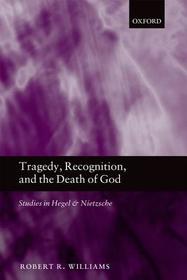
Tragedy, Recognition, and the Death of God
Studies in Hegel and Nietzsche
-
10% KEDVEZMÉNY?
- A kedvezmény csak az 'Értesítés a kedvenc témákról' hírlevelünk címzettjeinek rendeléseire érvényes.
- Kiadói listaár GBP 125.00
-
56 437 Ft (53 750 Ft + 5% áfa)
Az ár azért becsült, mert a rendelés pillanatában nem lehet pontosan tudni, hogy a beérkezéskor milyen lesz a forint árfolyama az adott termék eredeti devizájához képest. Ha a forint romlana, kissé többet, ha javulna, kissé kevesebbet kell majd fizetnie.
- Kedvezmény(ek) 10% (kb. 5 643 Ft)
- Kedvezményes ár 50 794 Ft (48 375 Ft + 5% áfa)
Iratkozzon fel most és részesüljön kedvezőbb árainkból!
Feliratkozom
56 437 Ft

Beszerezhetőség
Megrendelésre a kiadó utánnyomja a könyvet. Rendelhető, de a szokásosnál kicsit lassabban érkezik meg.
Why don't you give exact delivery time?
A beszerzés időigényét az eddigi tapasztalatokra alapozva adjuk meg. Azért becsült, mert a terméket külföldről hozzuk be, így a kiadó kiszolgálásának pillanatnyi gyorsaságától is függ. A megadottnál gyorsabb és lassabb szállítás is elképzelhető, de mindent megteszünk, hogy Ön a lehető leghamarabb jusson hozzá a termékhez.
A termék adatai:
- Kiadó OUP Oxford
- Megjelenés dátuma 2012. szeptember 27.
- ISBN 9780199656059
- Kötéstípus Keménykötés
- Terjedelem424 oldal
- Méret 240x162x28 mm
- Súly 764 g
- Nyelv angol 0
Kategóriák
Rövid leírás:
Robert R. Williams offers a bold new account of divergences and convergences in the work of Hegel and Nietzsche. He explores four themes - the philosophy of tragedy; recognition and community; critique of Kant; and the death of God - and explicates both thinkers' critiques of traditional theology and metaphysics.
TöbbHosszú leírás:
Hegel and Nietzsche are two of the most important figures in philosophy and religion. Robert R. Williams challenges the view that they are mutually exclusive. He identifies four areas of convergence. First, Hegel and Nietzsche express and define modern interest in tragedy as a philosophical topic. Each seeks to correct the traditional philosophical and theological suppression of a tragic view of existence. This suppression of the tragic is required by the moral vision of the world, both in the tradition and in Kant's practical philosophy and its postulates. For both Hegel and Nietzsche, the moral vision of the world is a projection of spurious, life-negating values that Nietzsche calls the ascetic ideal, and that Hegel identifies as the spurious infinite. The moral God is the enforcer of morality. Second, while acknowledging a tragic dimension of existence, Hegel and Nietzsche nevertheless affirm that existence is good in spite of suffering. Both affirm a vision of human freedom as open to otherness and requiring recognition and community. Struggle and contestation have affirmative significance for both. Third, while the moral God is dead, this does not put an end to the God-question. Theology must incorporate the death of God as its own theme. The union of God and death expressing divine love is for Hegel the basic speculative intuition. This implies a dipolar, panentheistic concept of a tragic, suffering God, who risks, loves, and reconciles. Fourth, Williams argues that both Hegel and Nietzsche pursue theodicy, not as a justification of the moral God, but rather as a question of the meaningfulness and goodness of existence despite nihilism and despite tragic conflict and suffering. The inseparability of divine love and anguish means that reconciliation is no conflict-free harmony, but includes a paradoxical tragic dissonance: reconciliation is a disquieted bliss in disaster.
an exceptional, remarkable book. Written in clear and precise languageit provides a powerful, extremely convincing argument against those deflationary readings that regard the metaphysical, theological, and religious dimensions of Hegel's philosophy as dispensable.
Tartalomjegyzék:
Introduction
Part I: Recognition
Hegel and Nietzsche on Master and Slave
Aristotle, Hegel, and Nietzsche on Friendship
The Agon, Recognition, and Community
Part II: Tragedy
Hegel's Conception of Tragedy
Nietzsche on Tragedy
Part III: Overcoming the Kantian Frame: The True Infinite
Hegel's Concept of the True Infinite
Hegel's Recasting of Theological Proofs
Part IV: God beyond the Death of God
Theogenesis, Divine Suffering, Demythologizing the Demonic
Nietzsche on the Death of God and Eternal Recurrence
Hegel on the Death of God: the Inseparability of Love and Anguish
Nietzsche's Aesthetic Theodicy
Hegel's Death of God Theodicy

