

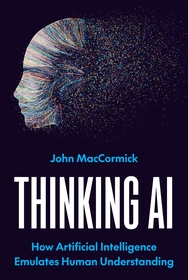
Thinking AI
How Artificial Intelligence Emulates Human Understanding
-
10% KEDVEZMÉNY?
- A kedvezmény csak az 'Értesítés a kedvenc témákról' hírlevelünk címzettjeinek rendeléseire érvényes.
- Kiadói listaár GBP 25.00
-
11 943 Ft (11 375 Ft + 5% áfa)
Az ár azért becsült, mert a rendelés pillanatában nem lehet pontosan tudni, hogy a beérkezéskor milyen lesz a forint árfolyama az adott termék eredeti devizájához képest. Ha a forint romlana, kissé többet, ha javulna, kissé kevesebbet kell majd fizetnie.
- Kedvezmény(ek) 10% (cc. 1 194 Ft off)
- Kedvezményes ár 10 749 Ft (10 238 Ft + 5% áfa)
Iratkozzon fel most és részesüljön kedvezőbb árainkból!
Feliratkozom
11 943 Ft

Beszerezhetőség
Még nem jelent meg, de rendelhető. A megjelenéstől számított néhány héten belül megérkezik.
Why don't you give exact delivery time?
A beszerzés időigényét az eddigi tapasztalatokra alapozva adjuk meg. Azért becsült, mert a terméket külföldről hozzuk be, így a kiadó kiszolgálásának pillanatnyi gyorsaságától is függ. A megadottnál gyorsabb és lassabb szállítás is elképzelhető, de mindent megteszünk, hogy Ön a lehető leghamarabb jusson hozzá a termékhez.
A termék adatai:
- Kiadó Princeton University Press
- Megjelenés dátuma 2026. április 21.
- Kötetek száma Print PDF
- ISBN 9780691191737
- Kötéstípus Keménykötés
- Terjedelem296 oldal
- Méret 234x155 mm
- Nyelv angol
- Illusztrációk 82 b/w illus. 11 tables. 700
Kategóriák
Hosszú leírás:
Can a computer program think like a human?
“Can machines think?” Ever since Alan Turing posed this question in an influential 1950 paper, it has been central to research in artificial intelligence. More than seventy-five years after Turing’s paper, we grapple with it every time we wonder if Watson was actually smarter than Jeopardy! champions, or if ChatGPT really knows what it’s talking about. In Thinking AI, computer scientist John MacCormick explores Turing’s question from a perspective informed by a detailed understanding of the way modern AI systems work. MacCormick explains, in accessible fashion, the ideas behind the two main pillars of the twenty-first century AI revolution: deep neural networks and reinforcement learning.
MacCormick offers a tour of the most famous AI systems, including AlexNet and VGG16, deep neural networks for object recognition that led to a Nobel prize; DeepMind’s AlphaGo, which shocked AI researchers with its superhuman performance in the game of Go; and OpenAI’s ChatGPT, which stunned the world with its natural language capabilities. He describes how each system works, and points to parallels with human brain processes. Both human minds and computer programs, MacCormick explains, can induce intelligence through emergence: the capability for new phenomena to emerge from the interactions of many small, simple components. Does this mean that a computer program can think like a human? In many ways, MacCormick argues, the answer is yes. In Thinking AI, he reveals a new landscape of emergent intelligence—a world in which computer programs can emulate many or all aspects of human thinking but humanity retains its meaning and purpose.
"[A] clear-eyed guide to modern artificial intelligence and the philosophical debates surrounding it. Structured like a well-designed undergraduate course, the book moves briskly through core ideas in AI and philosophy of mind, without oversimplifying." Több

